Skip to content

How Much Does IPTV Cost in 2026? Real Price Ranges
Short answer: in 2026, how much IPTV costs comes down to one honest range — most legitimate IPTV services run about $10 to $25 a month, and a yearly plan usually drops the effective price well below that. You will see cheaper offers and you will see pricier ones, but that middle band is where stable, watchable streaming actually lives. Anything advertised far below it — “20,000 channels for $3 a month, forever” — is the part you need to read carefully, because the price tells you almost everything about whether the service will still exist next month.
I run a streaming service and test playback across Firestick, Android TV, Apple TV, and phones every day, so this guide is the pricing I would give a friend: what a fair number looks like, what your money pays for, and the cheap traps that cost more in the end.
How much does IPTV cost per month?
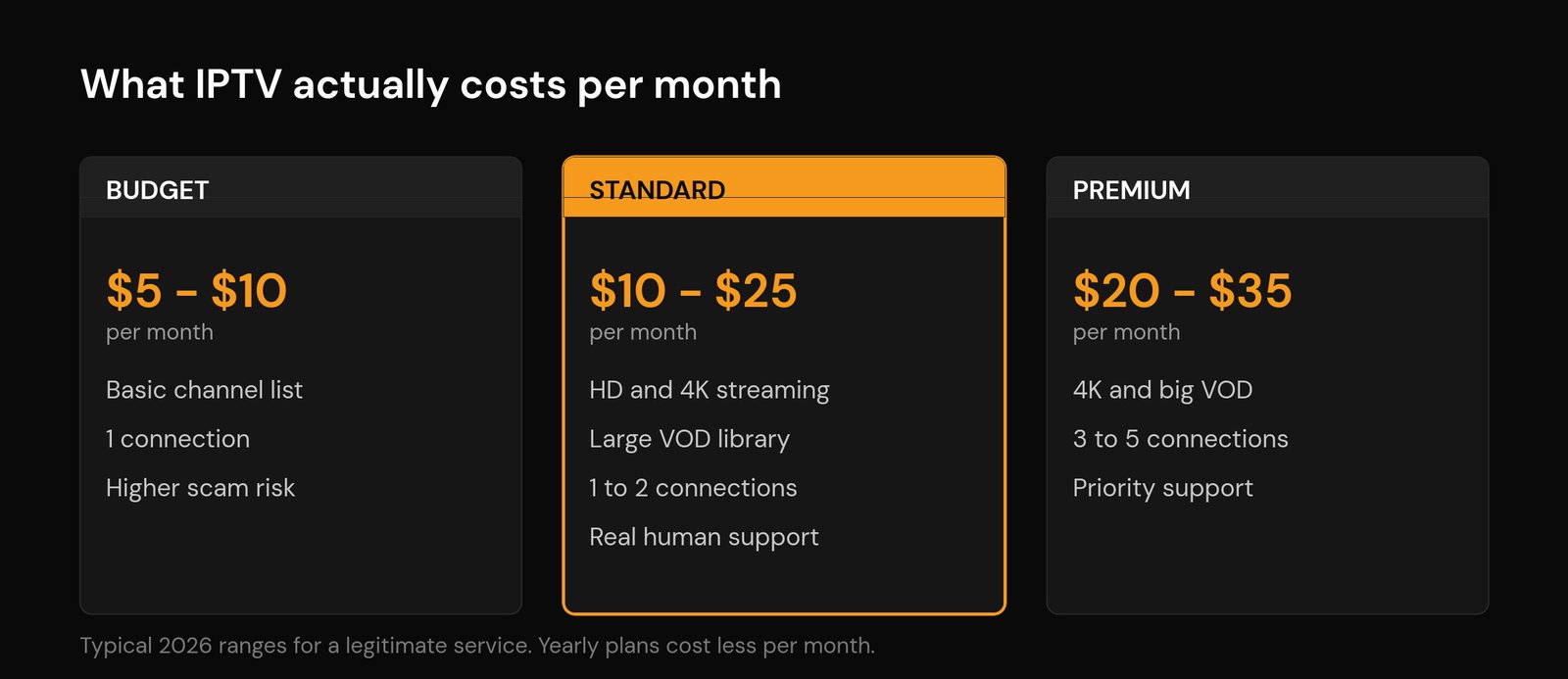
There is no single sticker price — IPTV is sold in tiers, and the monthly cost tracks how many connections you get, whether 4K is included, and how big the on-demand library is. Here is the lay of the land for a legitimate provider in 2026.
| Tier | Typical price / month | What you usually get | Best for |
|---|---|---|---|
| Budget | $5 – $10 | Basic channel list, 1 connection, smaller library, HD | One TV, light viewing, testing the water |
| Standard | $10 – $25 | HD and 4K, larger on-demand library, 1–2 connections, real support | Most households — the sweet spot |
| Premium | $20 – $35 | 4K, very large library, 3–5 connections, priority support | Big families, multiple rooms watching at once |
The average across the market lands near $15 a month for a standard plan. If you only ever watch on one screen, you do not need the premium tier — the extra money there mostly buys simultaneous connections you will never use. Budget for the number of TVs and phones that will actually stream at the same time, not the biggest package on the page.
Monthly vs yearly: which plan actually saves money
The billing cycle changes the real cost more than people expect. Paying month to month is the most flexible and the most expensive per month. Commit to a longer term and the effective price drops — a yearly plan is often 40–50% cheaper per month than paying monthly. The catch is that you are handing over more money up front to a service you may not have tested yet.
| Billing cycle | Effective cost / month | Up-front risk |
|---|---|---|
| Monthly | Highest | Low — walk away anytime |
| Quarterly / 3 months | A little lower | Moderate |
| Yearly / 12 months | Lowest (often ~half) | Higher — you prepay for a year |
My rule is simple: never sign up for a long term on day one. Start with a short month, or a low-cost test period, prove the service stays smooth during the evening rush, and only then move to the yearly rate to lock in the discount. The savings are real, but they are only a deal if the streams hold up. If a provider pushes you straight into a 12-month prepayment with no way to try first, that urgency is a warning, not a bargain.
What you are actually paying for
It is fair to ask why IPTV costs anything at all when “free” apps exist. The monthly fee is not for the app — the player is usually free. You are paying for the plumbing behind it: servers and bandwidth that can push thousands of simultaneous streams without choking, a content library that gets updated, and people who answer when something breaks. IPTV delivery over the internet runs on real infrastructure, and infrastructure has a monthly bill.
That is also why suspiciously cheap services fall apart exactly when you want them most. When a big live event pulls everyone onto the servers at once, an under-funded provider does not have the headroom, and you get buffering and freezing. A provider charging a fair price can afford the capacity. Roughly, your fee covers:
- Stable streaming capacity — enough server and bandwidth headroom to stay smooth at peak hours, not just at 2pm on a Tuesday.
- Picture quality — HD, FHD, and 4K feeds use more bandwidth, so higher-quality tiers cost the provider more to run. (Your side matters too — check the internet speed you need for 4K.)
- Connections — each extra screen streaming at the same time is another active stream the provider has to serve.
- Real support — a ticket system and humans who fix login or playlist problems, not a dead inbox.
Why “lifetime” and ultra-cheap deals are a trap
This is the single most important thing to understand about IPTV pricing: a one-time “lifetime” payment cannot fund a service that has monthly costs. The math does not work. A subscription business pays its server and bandwidth bills every month, so a provider that takes $50 once and promises forever is either going to vanish or was never planning to deliver. In practice these “lifetime” services tend to run for three to six months and then disappear — taking your money and leaving a dead app on your TV.
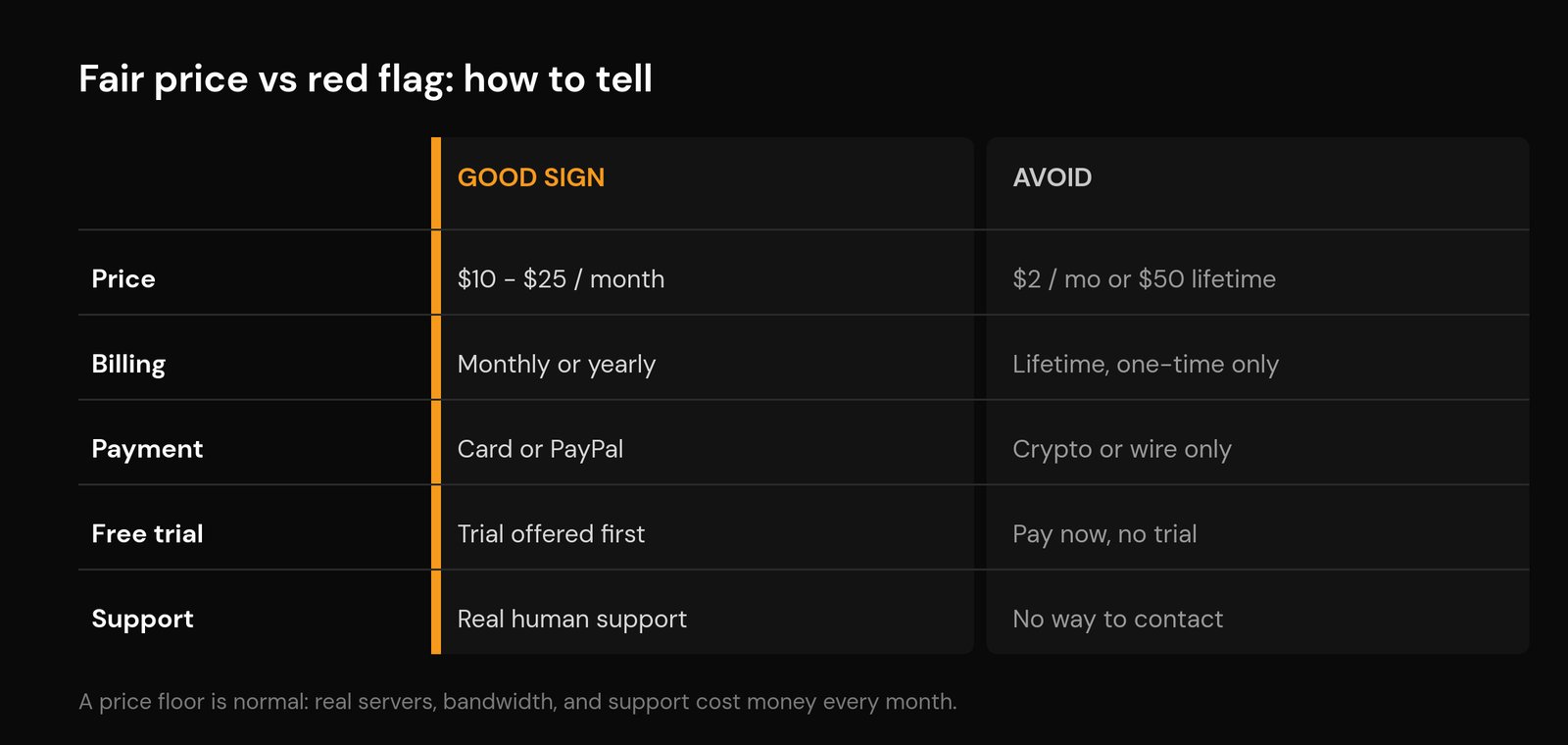
Price is the fastest scam detector you have. Treat these as red flags:
- “Lifetime” for one payment — the biggest tell. Sustainable services bill on a cycle.
- Far below the market — thousands of channels plus every premium feature for a couple of dollars a month is bait, not a business.
- Crypto or wire transfer only — legitimate providers take cards or trusted processors. Untraceable-only payment means no way to dispute. Here is how to pay for IPTV safely.
- Hidden activation or setup fees — a low headline price that balloons at checkout, sometimes followed by unexpected charges on your card.
- No trial and no refund policy — if they will not let you test, they are not confident in the product.
Cheap is not automatically a scam, and expensive is not automatically safe — but price that defies basic math almost always ends badly. For the wider picture, see how to avoid the common risks of using IPTV and why a legal, properly licensed service is worth paying a real price for.
IPTV cost vs cable and traditional TV
Against a traditional cable bill, IPTV is dramatically cheaper — which is the whole reason people switch. The average cable TV bill in the United States sits around $80 to $110 a month before the equipment rental, broadcast, and regional fees that quietly add another $20 to $50. A standard IPTV plan at $10 to $25, with no equipment rental and no contract, can cut that spend by more than half.
There is a trade-off worth being honest about. Cable hands you a polished, reliable signal and a single bill. With IPTV you bring your own streaming box or stick and a decent internet connection, and quality depends on your provider and your network. For most cord-cutters that is an easy trade, but it is a trade. We break the decision down fully in IPTV vs cable, and compare it with app-based on-demand streaming too.
Extra costs people forget to budget for
The subscription is the main line item, but a realistic budget includes a few one-offs and add-ons:
- A device — if you do not already own one, a streaming stick or IPTV box is a one-time $30 to $60. Most people already have a smart TV or phone that works.
- A faster connection — not strictly an IPTV cost, but 4K needs headroom; a plan upgrade is sometimes the real fix for buffering.
- A VPN (optional) — some users add one for privacy or to stop throttling, typically $3 to $12 a month. It is genuinely optional — see when a VPN actually helps with IPTV before you pay for one.
- Extra connections — going from 2 screens to 5 usually bumps you to a higher tier rather than a separate charge, but it is a cost to plan for.
How to get the best price without getting burned
You can pay the low end of the fair range and still get a service that lasts, if you buy in the right order. Start by reading our guide to choosing a reliable IPTV provider, then:
- Test before you commit. Use a short month or a low-cost trial period and watch during peak evening hours — that is when weak providers fail.
- Pay in a way you can dispute. A card or trusted processor gives you a chargeback if the service disappears; crypto does not.
- Only then go yearly. Once a provider has proven itself for a month, the annual rate is where the real savings are.
- Right-size the tier. Match connections to the screens you actually use at once, and skip 4K if your TV or connection cannot use it.
Once you have picked a plan, our step-by-step setup guide gets you watching in a few minutes on any device.
Frequently asked questions
How much does IPTV cost per month on average?
A standard IPTV plan averages around $15 a month in 2026, with most legitimate services priced between $10 and $25. Budget tiers start near $5 to $10, and premium plans with 4K and several simultaneous connections run $20 to $35.
Why is some IPTV so cheap?
Ultra-cheap and “lifetime” offers are usually unsustainable. Real services pay for servers, bandwidth, and support every month, so a price far below the market means the provider is cutting corners on capacity or planning to disappear. Those services often last only a few months.
Is a yearly IPTV plan worth it?
Yearly plans are often 40 to 50% cheaper per month than paying monthly, so they are worth it — but only after you have tested the service. Prepaying a year on an untested provider is the main way people lose money. Try a short month first, then lock in the annual rate.
Is IPTV cheaper than cable?
Yes, significantly. Cable averages roughly $80 to $110 a month before extra fees, while a standard IPTV plan is $10 to $25 with no equipment rental or contract — often more than 50% cheaper overall.
Are there hidden costs with IPTV?
The subscription is the main cost. Budget for a one-time streaming device ($30 to $60) if you need one, and optionally a VPN ($3 to $12 a month). Watch for providers that add activation or setup fees at checkout — that is a red flag.