Skip to content
IPTV vs OTT: Which One Are You Actually Using? (2026)
The short answer: IPTV and OTT both send video to you over the internet, but the how is completely different. IPTV runs on a managed, private network the provider controls end to end, so it can guarantee quality. OTT rides the open public internet — the same pipes as your email and everything else — so quality depends on whatever connection you happen to have. That single distinction explains almost every practical difference between them, from buffering to live-TV latency. The whole IPTV vs OTT debate really comes down to managed network vs open internet.
People use the terms interchangeably, and honestly most viewers can’t tell which one they’re watching. But if you’re choosing a service, troubleshooting buffering, or just curious why your live stream lags a few seconds behind a friend’s TV, the difference matters. Let’s break it down in plain language.
Which one are you actually using? A 30-second test
Before the definitions, the practical question. Check three things about the service you pay for:
- Where did the login come from? A dedicated box and a cable from your internet company, installed by them, points to true IPTV. A username and password you type into an app you picked yourself points to OTT.
- Does it count against your data cap? Managed IPTV delivered by your own ISP usually does not, because it never crosses the public internet. If your viewing eats your allowance, it is riding the open internet.
- What happens when the house gets busy? Managed IPTV holds up while everyone else is online, because bandwidth is reserved for it. If the picture falls apart the moment somebody starts a big download, nothing is being reserved for you.
Three noes and you are on OTT, whatever the service calls itself. Which leads straight to the part most comparisons leave out.
Why most services sold as “IPTV” are technically OTT
This is the most useful thing to understand about the whole comparison, and it is rarely said plainly: the subscriptions people buy and call IPTV are, by the strict technical definition, OTT.
The original meaning of IPTV is narrow. It describes television delivered over a network the operator owns and controls end to end — typically a telco carrying TV on a reserved slice of the same line that brings your broadband, with quality of service guaranteed on that slice. That control is the only reason it can promise a picture that OTT cannot.
A subscription bought from a website, logged into with a playlist link, and watched on a stick you chose yourself does none of that. It crosses the open public internet, through your ISP, alongside everything else in the house. It uses IP — but so does every video service ever built. The name stuck because the experience looks like traditional television, numbered live channels and a scrolling guide, not because the network underneath matches the definition.
Why that is more than a terminology point:
- Nobody is guaranteeing your quality. When marketing borrows the word IPTV to suggest managed-network reliability, that reliability is not there to borrow. Buffering becomes a shared-internet problem, solvable only at your end and the provider’s servers.
- Your connection is the variable, not the product. With true IPTV the operator owns the entire path. With OTT the path crosses networks nobody in the transaction controls, which is why an identical service is flawless for one person and unwatchable for their neighbour.
- It explains why the fixes are what they are. Wired Ethernet, DNS changes, router tuning and peak-hour advice all exist because the traffic is on the open internet, and headroom on your own line is the thing you control. None of it would be the answer on a genuinely managed connection — there would be nothing to tune.
So the honest answer to “is IPTV better than OTT” is that most people asking are not choosing between them at all. They are on OTT, and the useful question becomes how to give an open-internet stream the best conditions you can.
What IPTV actually is
IPTV stands for Internet Protocol Television — television delivered as data packets over an IP network instead of through an antenna, satellite dish, or coax cable. The key word is managed. Traditional IPTV is run by an operator (often a telecom or ISP) that controls the entire path from its servers to your screen.
Because the operator owns that network, it can prioritise TV traffic over everything else. It reserves bandwidth, marks packets so they get handled first, and keeps the whole pipeline tuned for smooth, predictable playback. You usually watch through a dedicated set-top box or an app the provider supplies. The experience feels like regular TV: channels load fast, live streams stay in sync, and buffering is rare because the network was built specifically for it.
If you want the longer version, our guide on what an IPTV service is walks through the moving parts, and what an IPTV app does covers the player side.
What OTT streaming is
Over-the-top (OTT) means the video is delivered “over the top” of any internet connection, without the content company owning or managing the network in between. The on-demand streaming platforms most people use every day are OTT services. They push video out from the cloud, lean on content delivery networks (CDNs) to get it close to you, and then it travels the public internet to your device.
The provider has no control over your home Wi-Fi, your ISP, or the congested node three hops away. So OTT leans on a clever trick called adaptive bitrate streaming: the video is encoded at several quality levels at once, and the player quietly switches between them based on how much bandwidth you have at that moment. Connection dips, the picture softens for a few seconds, then sharpens again. That’s the trade-off — OTT works on practically any connection, anywhere, but the quality flexes with your network.
The core difference: managed network vs open internet
This is the heart of the whole comparison. IPTV is a closed, controlled environment. OTT is the open road. Everything else flows from there.
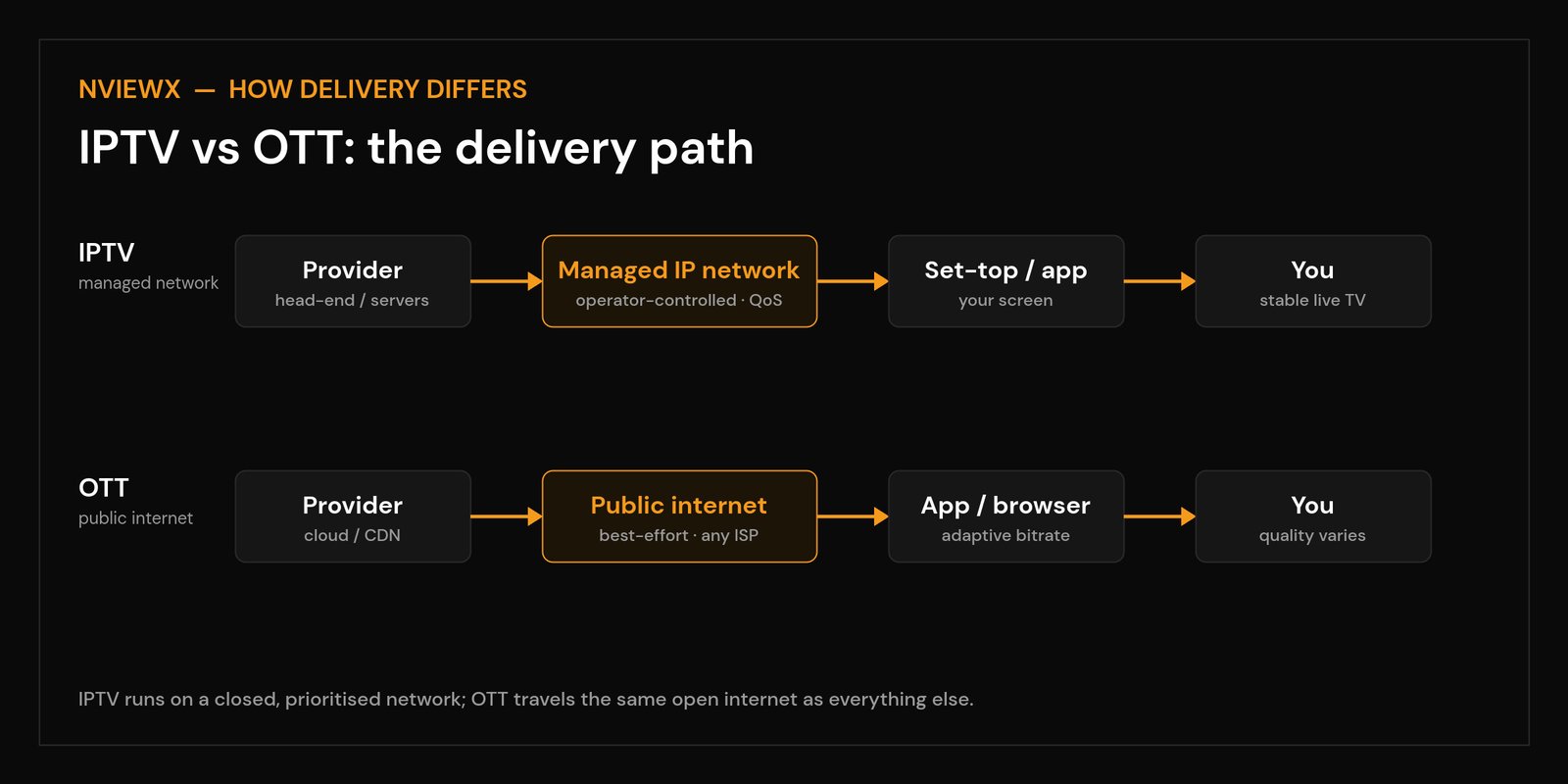
On a managed IPTV network, the operator can promise a level of service — what engineers call Quality of Service (QoS). They can guarantee bandwidth, cap latency, and keep packet loss near zero, because no one else is competing for that capacity. OTT is “best-effort” by design: the provider does its best, the CDN helps a lot, but nobody can promise your living room a clean stream when your network is having a bad night.
One nuance worth knowing: in everyday speech, plenty of subscription services that travel the open internet still get called “IPTV” because they use IP to deliver TV-style channels. Technically those are OTT. The honest line is about the network underneath, not the marketing label on the box.
Delivery and quality, side by side
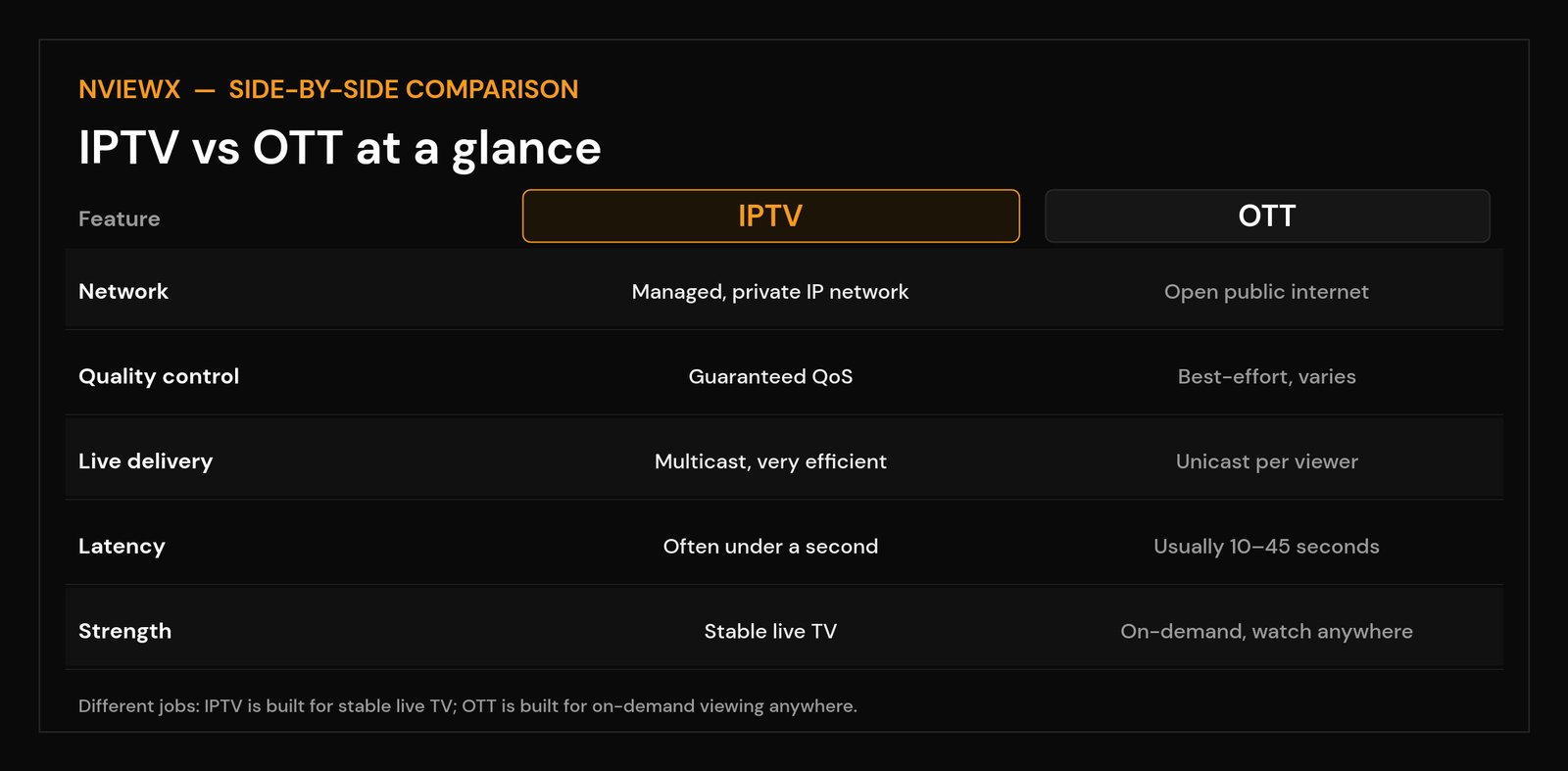
For live channels, IPTV often uses multicast — one stream serves thousands of viewers at once, which is wildly efficient. OTT uses unicast: every viewer gets their own individual stream from the CDN. Unicast is simpler to scale across the open internet but uses far more total bandwidth for the same live event.
On protocols, IPTV typically relies on multicast-friendly methods (IGMP, RTSP), while OTT is built on HTTP-based streaming like HLS and DASH — the same web technology that makes it play in any browser or app. That’s a big reason OTT goes everywhere a screen and a connection exist, while classic IPTV tends to stay inside the operator’s footprint.
Live vs on-demand
This is where the two play to their strengths. IPTV was born for live, linear TV — channels you flip through in real time. Its managed network keeps live latency astonishingly low, often under a second, which is why a goal in a live sports match shows up on a true IPTV feed almost instantly.
OTT shines at on-demand — movies and series you start whenever you like, on whatever device is nearby. OTT does live too, and it’s getting better fast, but live OTT streams have historically lagged 10 to 45 seconds behind real time because of how HTTP streaming buffers and chunks the video. Low-latency variants are closing that gap, yet a managed network still wins on raw live responsiveness. If you’ve ever heard the neighbours cheer before your stream caught up, that lag is OTT latency in action.
Where IPTV and OTT overlap
The line blurs more every year. Modern services mix both: an operator might run a managed core for its premium live channels and use OTT-style adaptive streaming for the catch-up and on-demand library. Many players you install on a streaming stick speak both worlds — they’ll happily play an M3U playlist whether the stream behind it is multicast IPTV or unicast OTT. From the sofa, you often can’t tell, and that’s fine.
Whichever you’re using, getting it onto your TV is the same kind of job. Our walkthroughs on how to set up IPTV and installing IPTV on a Firestick apply to both, and if your service hands you login details rather than a file, see what Xtream Codes are.
Which one matters for you
Be honest about how you watch. If your day is live channels — news in the morning, live sports at night — and you want them rock-solid and in sync, a managed IPTV-style service is built for exactly that. If you mostly graze on-demand titles across a phone, tablet, laptop, and a TV in different rooms, OTT’s go-anywhere flexibility is the better fit.
For most homes the practical answer is “both, in one app.” You don’t really pick IPTV or OTT anymore; you pick a service whose live performance and on-demand library both hold up on your connection. The real differentiators that decide your experience are uptime, server quality, a clean channel guide, and how well the stream copes when your Wi-Fi wobbles — not which acronym is printed on the website.
IPTV vs OTT: quick comparison table
| Aspect | IPTV | OTT |
|---|---|---|
| Network | Managed, private IP network the operator controls | Open public internet (any ISP) |
| Quality control | Guaranteed QoS, very stable | Best-effort, depends on your connection |
| Live delivery | Multicast — one stream, many viewers | Unicast — one stream per viewer |
| Protocols | IGMP / RTSP (multicast) | HLS / DASH over HTTP (adaptive) |
| Live latency | Often under a second | Usually 10–45 seconds (improving) |
| Best for | Stable live, linear TV | On-demand, watch anywhere |
| Reach | Within the operator’s network | Anywhere with internet |
Frequently asked questions
Is IPTV better than OTT?
Neither is “better” — they’re built for different jobs. IPTV wins on rock-solid live TV with low latency thanks to its managed network. OTT wins on flexibility and on-demand viewing across any device. For live channels, IPTV’s consistency is hard to beat; for binge-watching anywhere, OTT is more convenient.
What is the main difference between IPTV and OTT?
The network underneath. IPTV travels a private, managed network where quality can be guaranteed. OTT travels the open public internet on a best-effort basis, so quality depends on your own connection.
Does OTT use the internet and IPTV doesn’t?
Both use IP (internet protocol) to deliver video. The difference is whose network. IPTV uses the operator’s controlled IP network; OTT uses the public internet that everyone shares.
Why is my live OTT stream behind real time?
HTTP-based streaming (HLS/DASH) buffers video in small chunks before playing, which adds 10–45 seconds of delay on live events. Low-latency modes reduce it, but a managed IPTV feed still responds faster because it isn’t chunking over the open internet.
Can one app do both IPTV and OTT?
Yes. Most modern streaming players don’t care what’s behind the stream — load a playlist and they’ll play managed and over-the-top sources alike. From your sofa, the two often look identical.
Is OTT cheaper than IPTV?
It varies by provider, not by the technology. OTT can be cheaper to run because it doesn’t need a dedicated managed network, but pricing depends on the service, the content library, and the quality you’re paying for — not on the IPTV-vs-OTT label.
Which one should I choose for live sports?
If split-second timing matters, a managed IPTV-style service with low live latency keeps you in sync with the action. OTT live is improving and perfectly watchable, but it can still trail real time by several seconds.
Want both without thinking about the plumbing? Nviewx delivers stable live channels and a deep on-demand library in one app, tuned to stay smooth even when your connection isn’t perfect — so you get the best of IPTV and OTT in a single subscription.