Skip to content
Unauthorized IPTV Charges: How to Spot, Stop, and Prevent Them
Unauthorized IPTV charges usually show up for one of two reasons: a service quietly auto-renewed your plan, or your card details were captured and reused by someone you never intended to pay. The first is annoying. The second is fraud. Either way, the fix is the same playbook: check your statement closely, lock down how you pay, and dispute anything you did not approve fast.
This guide walks through why these charges happen, the warning signs on your statement, and the concrete steps that keep your card safe. If you are new to how streaming-over-internet works at all, our explainer on what an IPTV service is gives you the background.
Why unauthorized IPTV charges happen
Paying for any subscription means handing your card number to a stranger and trusting them to charge only what you agreed to. Most legitimate businesses do exactly that. The trouble starts with sellers who are careless, dishonest, or both. When a provider has weak security or shady intent, your card data can be stored insecurely, resold, or reused well after your one payment.
Security researchers have repeatedly found this pattern with low-trust streaming sellers. In one widely reported test, investigators paid roughly 20 dubious services and, within weeks, saw fraudulent charges appear from several countries totaling around $1,495 — strangers running purchases on cards that had only ever touched those checkout pages. The lesson is simple: who you give your card to matters as much as the price.
The most common causes
Not every surprise charge is criminal. Knowing which bucket yours falls into tells you what to do next.
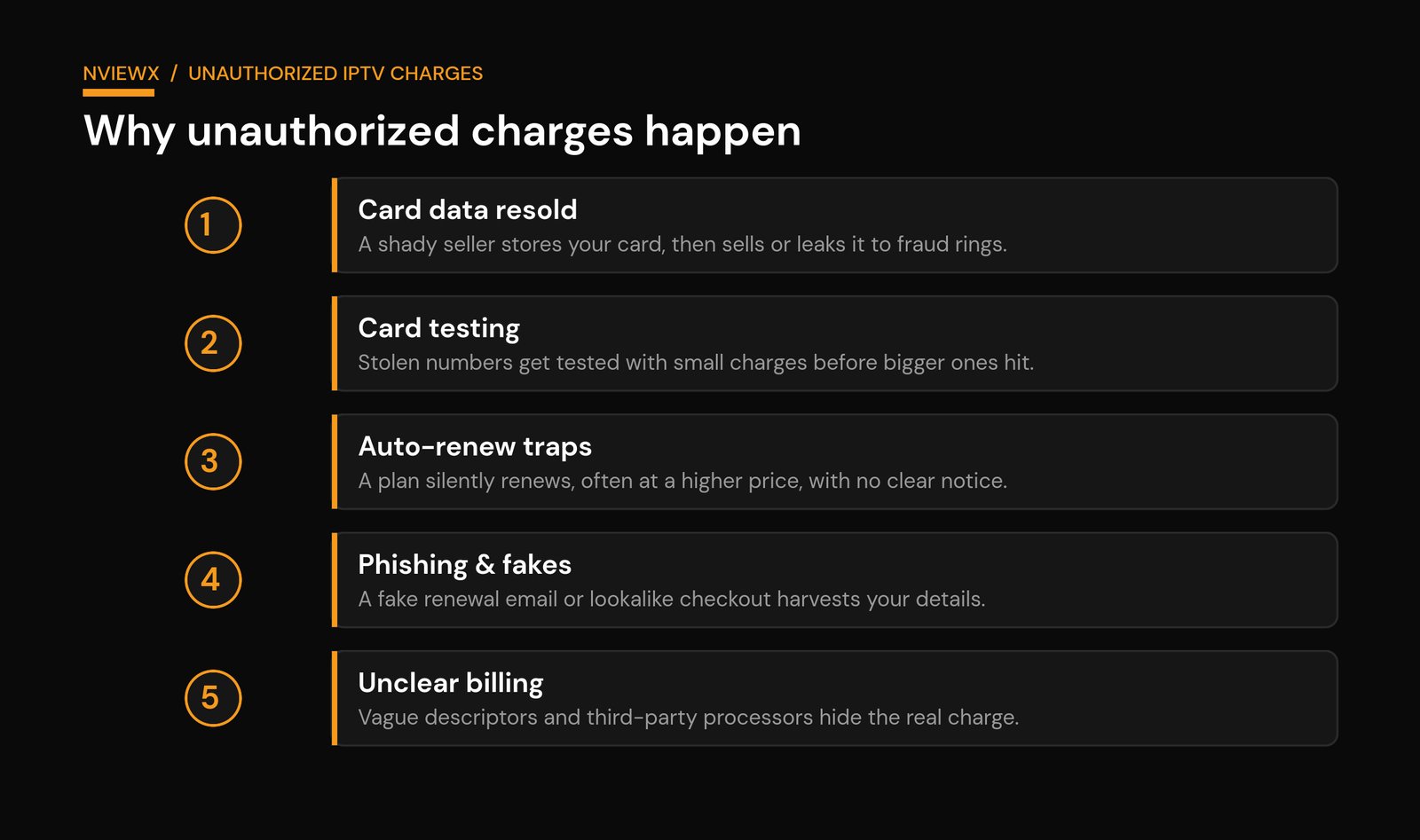
Card data resold or leaked
A seller stores your full card details and then sells them, leaks them in a breach, or hands them to a fraud ring. This is the worst case because the charges often come from merchants and countries you have never dealt with. It is closely tied to credit card fraud more broadly.
Card testing with small amounts
When a stolen number is fresh, fraudsters run tiny charges — a dollar or two — to confirm the card still works before attempting anything large. A small, odd charge you do not recognize is often the first domino, not a rounding error.
Auto-renew traps
Plenty of services default to automatic renewal. You buy a month, forget about it, and the card gets hit again — sometimes at a higher price than your intro rate, sometimes with the cancel button buried deep in account settings. That charge is technically authorized, but it can feel just as unwelcome.
Phishing and lookalike checkouts
A fake renewal email or a checkout page dressed up to look like the real one harvests your card the moment you type it in. If you arrived at a payment screen by clicking a link in an email or message, slow down. Phishing is one of the most common ways card details get stolen.
Unclear billing descriptors
Some charges hide behind a vague company name or a third-party payment processor, so the line on your statement looks nothing like the service you signed up for. That ambiguity is sometimes accidental and sometimes deliberate — either way it makes fraud harder to catch.
Warning signs on your statement
Catching a bad charge early is mostly about reading your statement like you mean it. Watch for:
- Charges you do not recognize, especially from foreign merchants or unfamiliar processor names.
- Small “test” amounts — a $1–$3 charge that does not match anything you bought.
- A renewal you forgot about, or a renewal at a price higher than what you originally paid.
- Duplicate charges for the same service in the same billing cycle.
- Charges that keep recurring after you thought you canceled.
Make it a habit to scan every line once a month rather than only glancing at the total. Fraudsters count on people not looking closely.
How to protect your payment info
The goal is to limit how much damage any single seller can do with your card. A few habits go a long way.
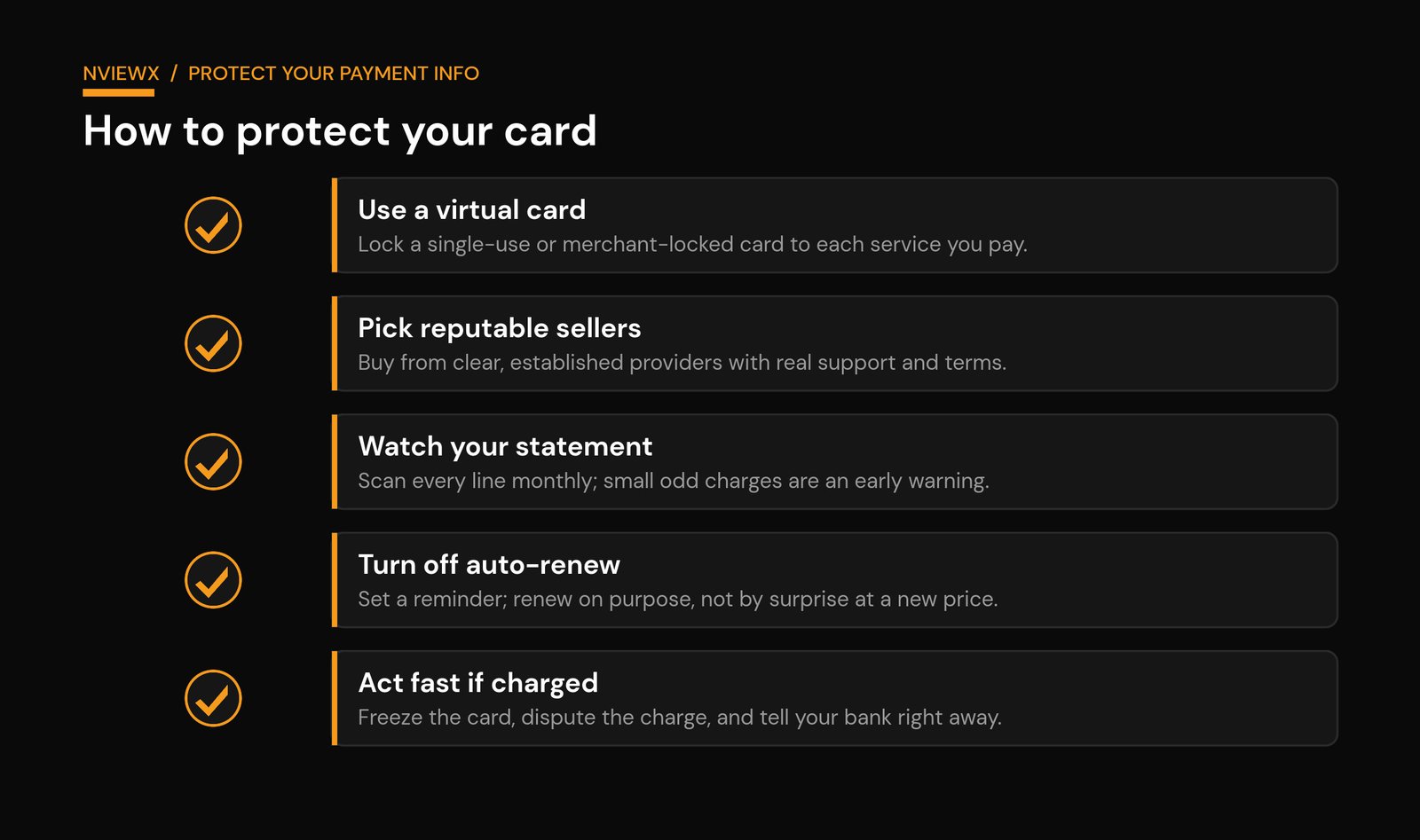
Use a virtual or single-use card
Many banks and payment apps let you generate a virtual card number that is locked to one merchant or capped at a set limit. If that seller is ever breached, only that one number is exposed — you delete it and the leak is dead. For a free trial, a single-use card that expires after one charge is ideal.
Buy from reputable, transparent sellers
Stick to providers with clear pricing, real terms, working support, and an honest billing descriptor. If the only way to pay is an unusual method, the terms are vague, or the price is implausibly low, treat it as a red flag. Our guide on how to avoid the risks of using IPTV covers what a trustworthy setup looks like, and how to get a legal IPTV service explains why the legitimate route is also the safer one for your wallet.
Turn off auto-renew when you can
If you do not need continuous service, disable automatic renewal and set a calendar reminder a few days before your plan ends. Renew on purpose, at a price you have seen, instead of being charged by surprise.
Watch your statement and your device
Review charges monthly, turn on transaction alerts from your bank, and keep your payment apps and devices updated. Privacy and security overlap here — if you are curious whether your hardware itself is a risk, we looked at whether an IPTV box can spy on you.
What to do if you are charged
If a charge you did not approve appears, move quickly — timing affects how much protection you get.
- Freeze or lock the card in your banking app so no further charges go through.
- Contact your bank or card issuer using the number on the back of the card or in the official app — not a number from an email. Report the charge as unauthorized.
- Dispute the transaction. Issuers can reverse fraudulent charges, and consumer-protection rules in many countries cap your liability when you report promptly.
- Request a new card number if your details were exposed, so any leaked copy becomes useless.
- Document everything — dates, amounts, and any reference numbers from your bank.
Act fast. Many fraud protections are time-sensitive, and the sooner you report, the less you are typically on the hook for.
Cause and prevention at a glance
| Cause | How to prevent it |
|---|---|
| Card data resold or leaked | Use a virtual/merchant-locked card and buy only from reputable sellers. |
| Card testing (small charges) | Turn on transaction alerts; report any tiny unrecognized charge. |
| Auto-renew traps | Disable auto-renew; set a reminder and renew deliberately. |
| Phishing / fake checkout | Never pay via email links; type the site address yourself. |
| Unclear billing descriptors | Note the exact descriptor at purchase so you can match it later. |
| Slow fraud response | Freeze the card and dispute the charge the moment you spot it. |
Frequently asked questions
- Why am I seeing an IPTV charge I do not recognize?
- It is usually one of three things: a subscription that auto-renewed, a duplicate or test charge from a careless or fraudulent seller, or your card details being reused after a leak. Match the billing descriptor to services you have actually signed up for. If nothing matches, treat it as unauthorized and contact your bank.
- Can paying for a streaming service get my card stolen?
- It can if the seller is untrustworthy. Low-trust providers have been caught storing and reselling card data, which leads to charges from merchants you never dealt with. Paying reputable, transparent providers with a virtual card dramatically lowers that risk.
- How do I stop a service from charging me again?
- Cancel inside your account and turn off auto-renew, then confirm in writing if possible. If charges continue after you cancel, lock the card, dispute the charges with your bank, and request a new card number so the old one cannot be used.
- Are virtual cards actually safer for subscriptions?
- Yes. A virtual or single-use card limits exposure to one merchant and one amount, so a breach or rogue charge only affects that single number, which you can delete instantly without replacing your real card.
- What is card testing and why does it matter?
- Card testing is when someone runs a very small charge to verify a stolen number works before attempting larger purchases. A tiny, unexplained charge is often an early warning that your details are compromised, so do not ignore it.
- How fast should I report an unauthorized charge?
- As soon as you spot it. Many consumer protections limit your liability only if you report promptly, and some windows are measured in days. Freezing the card and calling your issuer the same day gives you the strongest position.
- Does using a VPN protect me from unauthorized charges?
- A VPN protects your connection privacy but does not stop a seller from misusing card details you handed them. For billing safety, focus on who you pay and how, not just your network.
The bottom line
Most unauthorized IPTV charges trace back to two things you can control: who you trust with your card and how closely you watch what they do with it. Pay reputable providers, use a virtual card, turn off auto-renew you do not need, and read your statement every month. If something slips through, freeze the card and dispute it the same day.
At Nviewx we keep billing transparent and only charge what you agreed to — part of running a service people can trust. If you want a clean, predictable subscription without the surprise-charge headaches, that is exactly what we aim for.
This article is general information, not financial or legal advice. For your specific situation, contact your bank, card issuer, or a qualified professional.