Skip to content
Legal IPTV Providers: How to Verify One in 2026
A legal IPTV service is one that pays to carry every channel it streams — it holds licensing agreements with the content owners, runs as a registered business, and charges a price that actually covers those rights. So getting a legal IPTV setup comes down to one habit: before you pay, check that the provider can show it licenses its content and operates openly. This guide walks through what “legal IPTV” really means, a quick way to tell a legitimate service from a sketchy one, the red flags worth walking away from, and how to verify a provider before your card details go anywhere near it.
One thing up front: laws differ a lot from country to country, and this is general information, not legal advice. If you want a firm answer for where you live, check your local regulations or ask a qualified professional. What follows holds true almost everywhere — the legality of an IPTV service hinges on whether the underlying content is properly licensed.
What “legal IPTV” actually means
IPTV — Internet Protocol television — is just a delivery method. It sends TV over an internet connection instead of an aerial, satellite dish, or cable. The technology itself is completely legal; your phone, your smart TV, and most mainstream streaming apps all use it. What makes a service legal or not is the content it carries and whether it has the right to carry it.
A legitimate provider signs carriage and licensing deals with the broadcasters, studios, and rights holders behind the channels and on-demand titles it offers. It pays them, usually per subscriber, and that cost is baked into your subscription. An unauthorized service skips all of that — it grabs streams it has no rights to and resells them. The picture might look identical on your screen, but legally and financially they are nothing alike. This is fundamentally a question of copyright: the rights holder controls who may redistribute their content, and a legal IPTV provider has paid for that permission.
A useful mental model: if a service offers thousands of premium channels and every live event imaginable for a few dollars a month, the math doesn’t work. Licensing premium live TV costs real money. A price that’s wildly below what licensed services charge is the single clearest sign the content isn’t licensed at all.
What a legal IPTV provider actually looks like
Searches for legal IPTV providers usually expect a list of names. A list is the one thing nobody can honestly hand you, because legality is decided per channel, per country and per date — a provider fully licensed where it operates may be carrying nothing it is allowed to sell you across the border, and the picture changes every time a contract renews. What can be given is the shape. There are only four kinds of provider that hold real rights, and everything legitimate is one of them.
- Your own internet or phone company. Operators that sell a TV package alongside broadband. They deliver over their own managed network, publish a registered company address and a tax number, and carry a short, regional line-up — because every entry on it was paid for.
- A licensed streaming platform’s live tier. Subscription services that began with on-demand and added live channels. Sold through the mainstream app stores, with published terms and a real support organisation behind them.
- Free ad-supported and public feeds. Advertising-funded and broadcaster-run channels that cost nothing to carry, because being carried is the entire point of them. Genuinely free and genuinely legal — which is exactly why “free” on its own is not a red flag.
- A licensed regional or community operator. Smaller operators serving one country, language or diaspora audience and licensed for precisely that territory. Legitimate, and the reason a service can look obscure and still be perfectly fine.
Notice what is missing. A service offering thousands of channels from dozens of countries for a few dollars a month is not a fifth category — it fits none of these, because nobody buys worldwide rights to everything and then sells the lot for less than a single licensed channel costs wholesale. That is the whole test, and it does not require you to recognise one brand name.
It also explains a result that catches people out: a legal provider usually looks worse on paper. Fewer channels, regional gaps, the occasional blackout, catch-up that expires after a set number of days. Those are licence boundaries showing through the picture. Their presence is evidence that somebody is honouring an agreement rather than ignoring one, and their total absence is the clearest signal you will get.
Two shortcuts before you go further. If a candidate service is already making you uneasy, the specific tells are collected in our guide to spotting a fake IPTV service. If the price is what is pulling you in, read what the trade-off actually is with free IPTV services first. And if you already pay for something you have decided to leave, switching providers cleanly is mostly a question of what order you do things in — cancel and re-subscribe the wrong way round and you lose access mid-month for nothing.
How to tell if an IPTV service is legitimate
You rarely get a certificate confirming a provider is legal. Instead you read the signals. Run through this checklist before you subscribe — a legitimate service clears most of it without you having to dig.
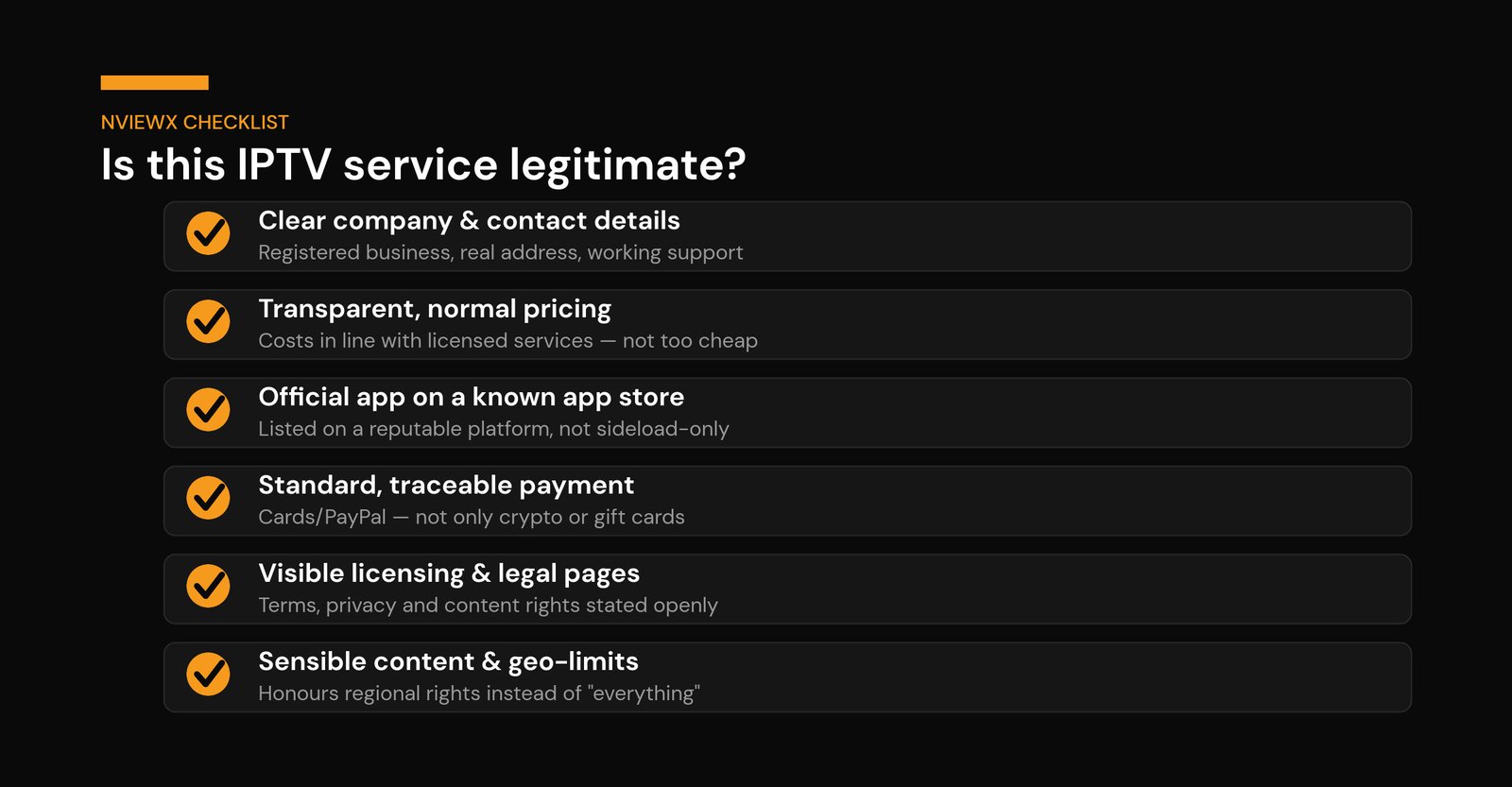
- It tells you who it is. A registered company name, a real address, and a support channel that answers — not just an anonymous checkout page and a chat handle.
- The price makes sense. It’s broadly in line with other licensed services, not a tenth of the cost. Cheap is fine; suspiciously cheap is the tell.
- There’s an official app on a known store. Apps that pass review on a major app store have had their licensing checked to some degree. Sideload-only services that exist nowhere but a website skip that scrutiny entirely.
- Payment is normal and traceable. Cards and mainstream processors come with buyer protection. Being pushed toward only crypto, gift cards, or wire transfers is a warning, not a convenience.
- Licensing and legal pages exist. Legitimate providers publish terms, a privacy policy, and often name the partnerships they’re proud of. Vague or missing legal pages are a gap.
- Content has sensible limits. Regional restrictions and a realistic channel list are actually good signs — they show the provider is honouring the deals it signed rather than promising literally everything.
None of these is proof on its own. Together they paint a clear picture. A service that ticks most of these boxes is almost certainly operating above board; one that fails several is worth avoiding regardless of how good the lineup looks.
Red flags of an unauthorized service
Some signals point the other way hard enough that I’d stop right there. If you see these, the service is most likely redistributing content it doesn’t own — and that brings risks well beyond a takedown notice.
- “Every channel, every event” for pocket change. The promise of unlimited premium content at an impossible price is the defining trait of unauthorized services. They can charge so little precisely because they pay nothing for rights.
- No business details anywhere. No company name, no address, support only through an encrypted messaging app. If something goes wrong, you have no one to hold to account.
- Untraceable payment only. Operators leaning on crypto, gift cards, or wire transfers are usually doing so to dodge chargebacks and stay hard to trace. Your card data handed to an outfit like that is genuinely at risk.
- Sideloading from unknown sources. Apps that live only on a random link, not any reputable store, can carry malware bundled into the installer. People think they’re getting a player; they’re also getting something they didn’t sign up for.
- Sloppy presentation. Grammatical errors, inconsistent branding, links that change weekly, and “buy now before it’s gone” pressure all point to a fly-by-night operation.
The consumer harms here are real and documented: malware planted in unofficial apps, payment and identity fraud from handing card details to anonymous operators, and the simple reality that a service running on stolen streams can vanish overnight — taking your subscription with it.
Why legitimacy actually protects you
Choosing a licensed service isn’t only about staying on the right side of the rules. It’s the practical choice, because legitimacy and reliability tend to travel together.
Your money and data are safer. A registered business taking card payments through a real processor gives you recourse — chargebacks, refunds, a name to complain to. Hand your details to an anonymous operator and you’ve none of that, plus the exposure to fraud that comes with it.
The service stays up. Unauthorized streams get shut down. When rights holders or providers issue takedowns, illicit services go dark without warning, often mid-event. A licensed service has no reason to disappear; it paid for the right to be there.
You’re not the security weak point. Apps from a vetted store and a provider with something to lose are far less likely to ship malware or quietly harvest your data. With an unknown sideloaded app, you’re trusting a stranger with whatever’s on your device.
Quality holds up. Providers paying for content tend to invest in the infrastructure to deliver it — stable streams, working guide data, real support when something breaks. “Too cheap” services skimp everywhere, and it shows the moment a lot of people tune in at once.
How to choose and verify a provider
Once you know the signals, vetting a provider takes about ten minutes. Here’s the order I’d go in.
- Find the company behind it. Look for a business name and registration. A provider proud of its licensing will say so; one hiding its identity is telling you something.
- Sanity-check the price. Compare it against mainstream licensed options. If it’s a fraction of the going rate for the same content, assume the content isn’t licensed.
- Look for the official app. Search the major app stores by name. A legitimate listing that’s been through review is reassuring; “download our APK from this link only” is not.
- Check how you’d pay. Card or a mainstream processor with buyer protection is what you want. Crypto-or-nothing is a reason to pause.
- Read the legal pages. Terms, privacy policy, refund policy, any licensing statements. Their presence and clarity tell you how seriously the provider takes operating properly.
- Start small. Where a short trial or a one-month plan exists, use it before committing to a year. It limits your exposure while you confirm the service does what it claims.
If you’re still setting things up on the technical side — understanding the building blocks helps you spot a legitimate service faster. It’s worth knowing what an IPTV service is, how Xtream Codes logins and M3U playlists work, and what an EPG (electronic programme guide) does. When you’re ready to connect a provider, our step-by-step IPTV setup guide covers the apps and settings.
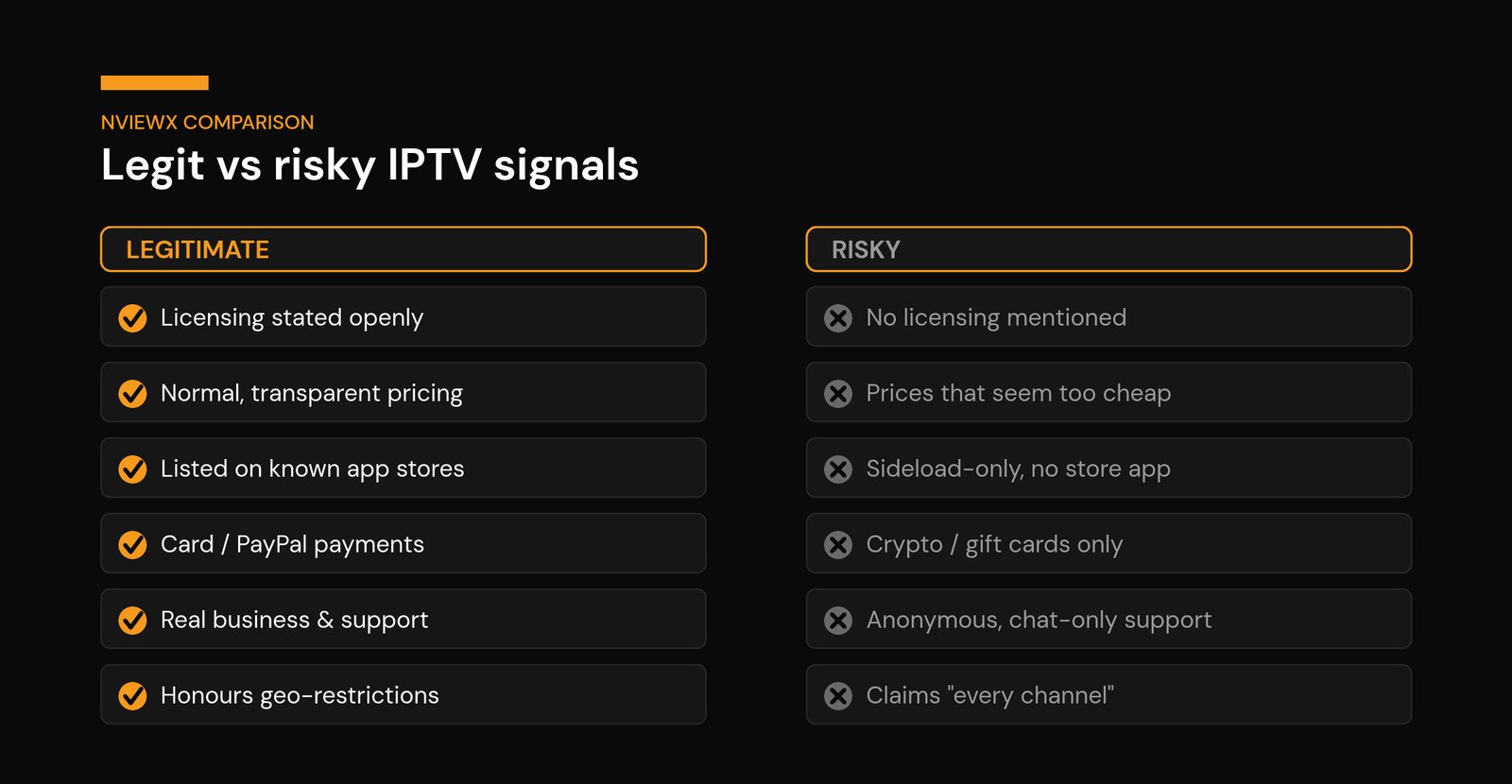
Legit vs risky signals at a glance
Here’s the whole thing condensed. Use it as a quick gut-check the next time a provider catches your eye.
| Signal | Legitimate service | Risky service |
|---|---|---|
| Business identity | Named, registered, contactable | Anonymous, chat-only |
| Pricing | In line with licensed services | Too cheap to be real |
| App distribution | Official app on a known store | Sideload-only from a link |
| Payment | Cards / mainstream processors | Crypto / gift cards only |
| Licensing & legal pages | Published and clear | Vague or missing |
| Content scope | Realistic, geo-aware | “Everything, everywhere” |
Frequently asked questions
Is IPTV legal?
The technology is. IPTV is simply television delivered over the internet, and it’s used by countless mainstream, fully licensed services. What can make a specific service illegal is streaming content it has no licence to distribute. Legality follows the content and its rights, not the delivery method.
How can I tell if an IPTV provider is legitimate?
Check for a named, registered business with real contact details, pricing that’s in line with other licensed services, an official app on a recognised store, normal traceable payment options, and clear legal pages. A provider that clears most of those is almost certainly operating legally.
Why are some IPTV services so cheap?
Because they don’t pay for the content. Licensed providers fund carriage and licensing deals, and that cost shows up in the price. A service charging a fraction of the going rate for the same premium content almost certainly isn’t paying for the rights to it.
What are the risks of using an unauthorized IPTV service?
Several, and they’re practical, not just legal. Apps from unknown sources can carry malware; anonymous operators taking untraceable payments expose you to fraud; and services running on streams they don’t own can be shut down without notice, taking your subscription with them.
Does using a VPN make an IPTV service legal?
No. A VPN changes how your connection is routed; it doesn’t change whether the content is licensed. If a service is being pushy about requiring a VPN to access content, treat that as a red flag rather than reassurance.
Is it safe to pay with crypto or gift cards for IPTV?
It’s a warning sign. Legitimate providers accept cards and mainstream processors that come with buyer protection. Being steered toward only untraceable payment methods usually means the operator wants to avoid chargebacks and stay hard to trace — not a position you want your money in.
Does the law on IPTV differ by country?
Yes, considerably. Copyright and broadcasting rules, and how strictly they’re enforced, vary from one country to the next. This guide is general information rather than legal advice — for a definitive answer where you live, check your local regulations or speak to a qualified professional.
What’s the safest way to get started with a legal IPTV service?
Vet the provider using the checklist above, start with a short trial or a single month rather than a long commitment, pay with a card so you have recourse, and use the official app from a recognised store. That keeps your exposure low while you confirm the service is what it claims to be.
At Nviewx we cover IPTV the straight way — how the technology works, how to set it up properly, and how to stay safe while you do it. Vet any provider before you pay, and you’ll get the streaming experience without the nasty surprises.