With Nviewx

Find the latest expert tips, high quality streaming, helpful friendly support all in one place.

what is an iptv service

A Comprehensive Guide to IPTV Service: Understanding Internet Protocol Television

In a world where streaming has become the dominant way we consume entertainment, IPTV service has emerged as the future of television. Unlike traditional cable or satellite television, IPTV uses internet protocols to deliver media content. This allows viewers to watch live TV, video on demand and even interact with their programming in ways conventional systems cannot match. In this comprehensive guide, we will explore every aspect of IPTV, from the underlying technology and market trends to legal considerations, setup guidelines and expert tips for getting the best viewing experience.

1. The Evolution of Television and the Rise of IPTV

The history of television has been marked by technological leaps—from analog broadcasts to cable TV, satellite services and now streaming platforms. Each new method has aimed to improve picture quality, expand channel offerings and provide greater convenience. IPTV represents the next evolutionary step, combining the vast content options of the internet with the reliability of television broadcasting. According to global market research, the IPTV market size is experiencing a boom. One study values the market at over USD 93 billion in 2025 and projects it to surpass USD 330 billion by 2034. Another report estimates the market at USD 100.9 billion in 2026 with growth reaching USD 404.1 billion by 2035. These figures reflect a compound annual growth rate of between 14.8 % and 16.7 %, underscoring that IPTV is not a passing trend but a fundamental shift in entertainment. Asia‑Pacific leads with roughly 105 million users—about 42 % of global subscribers—while North America accounts for nearly 44 % of subscriber share. Within the U.S., some 25 million households access television via IPTV. Behind these numbers lies a broader shift in how people watch content. Viewers now demand on‑demand access, high‑definition streams, multi‑screen support and personalized recommendations. Services like Nviewx cater to these requirements by offering high‑quality streaming packages. In this article, we will explain why IPTV has captured the imagination of so many consumers and how you can make the most of it.

2. Defining IPTV: What Is Internet Protocol Television?

At its core, IPTV is a system where television services are delivered using the Internet Protocol suite instead of traditional broadcast formats (terrestrial, satellite or cable). This means that your TV shows, movies and other media come through your internet connection rather than through coaxial cables or satellite dishes. The basic components of an IPTV service include:
  • Content sources: These can range from live TV channel feeds and video libraries to premium on‑demand libraries or user‑generated content. Content is encoded and prepared for distribution.
  • Delivery network: High‑speed broadband networks, fibre‑optic connections and content delivery networks (CDNs) transport data to the end user. Multicast protocols and adaptive bitrate streaming ensure efficient use of bandwidth.
  • Playback devices: Smart TVs, set‑top boxes, smartphones, tablets and even game consoles can receive and decode IPTV streams. Many services also offer apps for popular streaming devices like Roku, Fire TV and Apple TV.
Unlike video streaming services that rely heavily on over‑the‑top (OTT) content distribution, IPTV often uses dedicated networks or optimized protocols to ensure reliability. This distinction can be confusing because OTT providers share many features with IPTV. If you are curious about the differences, check out our in‑depth comparison “IPTV vs OTT: What’s the Difference?” on our blog.

2.1 IPTV vs Traditional Cable and Satellite TV

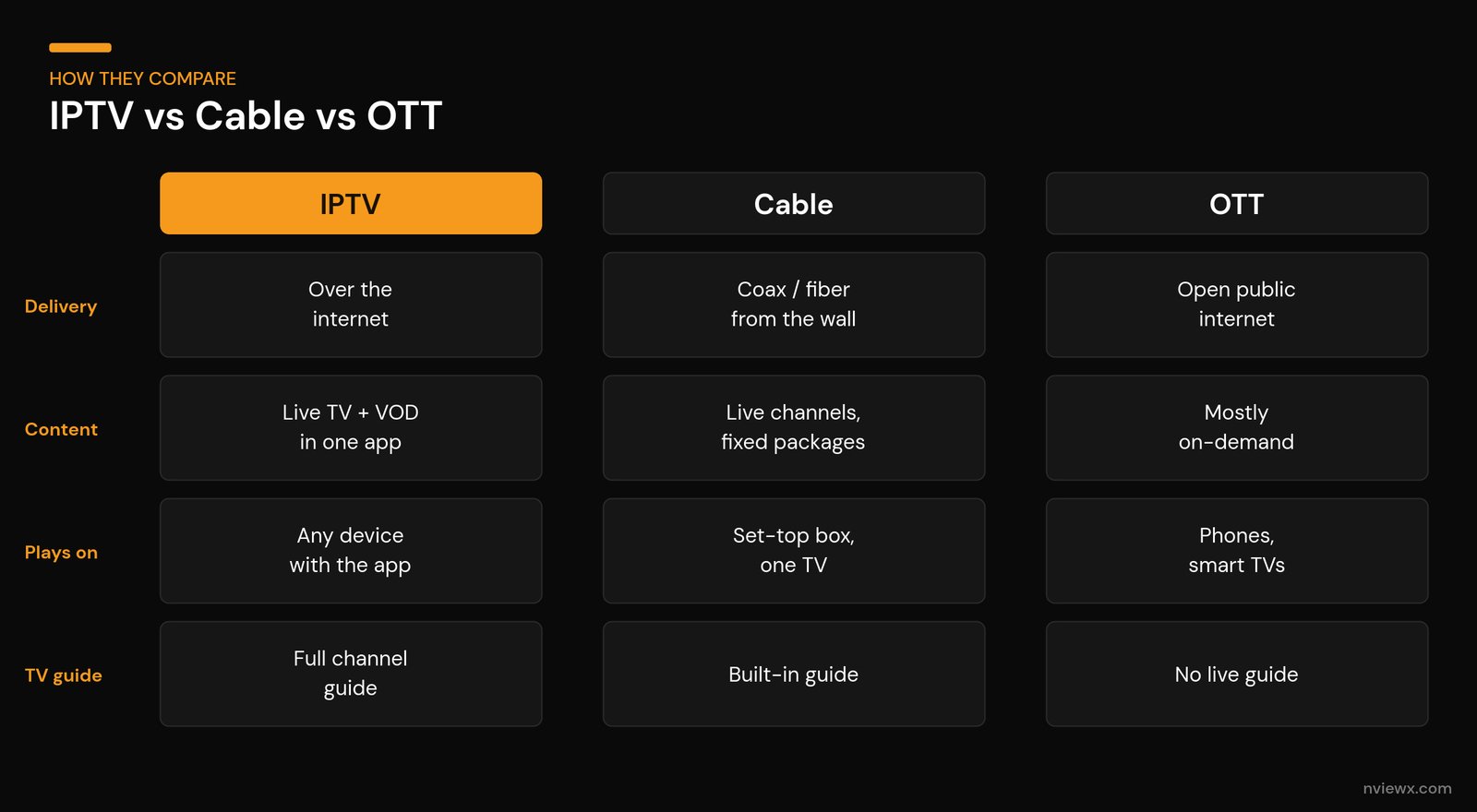
While cable and satellite have served millions of households for decades, they face limitations that IPTV addresses:
  • Channel limitations: Cable and satellite services must allocate a specific amount of bandwidth for each channel, which limits the number of channels they can offer. IPTV can deliver hundreds or thousands of channels because content is streamed on demand.
  • Equipment requirements: Cable often requires a set‑top box per TV and professional installation. IPTV typically needs only a broadband connection and a compatible device.
  • Interactivity: Cable and satellite provide limited interactive features. IPTV allows features like pause, rewind, time‑shifted viewing and on‑demand selections.
  • Flexibility: IPTV content can be watched on a wide range of devices—not just a television set but also on laptops, tablets and mobile phones. This flexibility is ideal for households with multiple viewing preferences.
Furthermore, IPTV is typically more cost‑effective. Without expensive infrastructure or licensing fees for satellite transponders, IPTV providers can offer more competitive plans. Users can choose specific channel bundles or pay‑per‑view content to suit their preferences. In some cases, viewers even subscribe to multiple IPTV providers to access specialized content such as regional sports or foreign channels.

2.2 Legal Considerations: Is IPTV Legal?

A common question about IPTV services is whether they are legal. The short answer is yes, IPTV is legal when the provider has obtained the proper licensing to distribute the content it offers. Reputable services like Nviewx secure licences from content owners and studios, ensuring that users enjoy high‑quality streams without violating copyright laws. However, piracy remains a problem in the streaming world. Some illegal IPTV services operate by redistributing broadcast feeds without paying rights holders. These illegal operations often lure users with low prices and wide channel lists but may shut down without notice, exposing subscribers to potential legal consequences. For this reason, it’s crucial to choose a verified, licensed IPTV provider. As pointed out in our article “How to Get a Legal IPTV,” you should verify the provider’s credentials, look for secure payment methods, and check whether their streams comply with copyright laws.

3. How Does IPTV Work? A Look Behind the Scenes

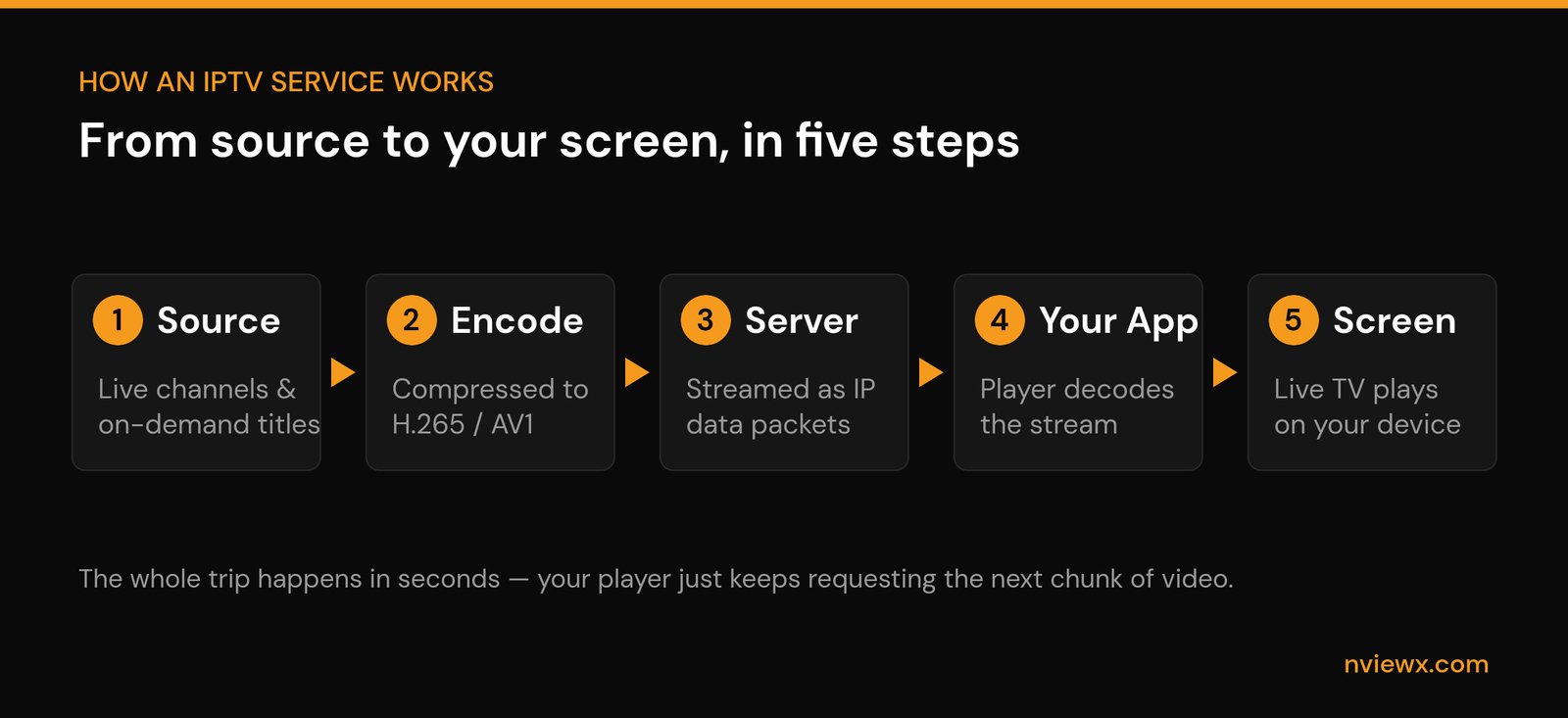
Understanding the mechanics of IPTV can help you diagnose issues and appreciate the technology’s sophistication. IPTV uses packet‑switched networking to send audio and video data through broadband connections. Here’s how the process unfolds:
  1. Content ingestion and encoding: Television stations and content owners provide feeds to an IPTV provider’s headend. The provider encodes the video and audio into digital formats (e.g., H.264, H.265 or AV1) to compress data efficiently.
  2. Content distribution: Encoded streams are sent over the internet via protocols like MPEG‑TS, HLS (HTTP Live Streaming) or DASH (Dynamic Adaptive Streaming over HTTP). These protocols break the video into small segments or packets.
  3. Adaptive bitrate streaming: The streaming server monitors network conditions and adjusts the quality of the stream dynamically (lower bitrates for slower connections; higher for faster). This ensures that viewers receive the highest possible quality without buffering.
  4. Multicast vs unicast: When multiple users watch the same live channel, multicast protocols (e.g., IP Multicast combined with IGMP—Internet Group Management Protocol) allow the network to send one stream to many viewers instead of sending separate streams to each. This saves bandwidth and improves stability.
  5. Decoding and playback: The end user’s device receives packets and decodes them into audio and video signals. Software or hardware decoders interpret the compression format and display the content on the screen.
Because IPTV relies on IP networks, it can integrate additional interactive features such as personalized recommendations, real‑time data overlays (e.g., sports statistics) and targeted advertising. This interactive capability is part of what makes IPTV services so appealing in our increasingly digital world.

4. Types of IPTV Services

IPTV offerings vary widely, reflecting different user preferences and content types. Here are the main categories of IPTV services:

4.1 Live Television

This is the traditional broadcast experience delivered via the internet. News channels, sports networks and live events can be streamed in real time. With live IPTV, viewers can switch channels instantly and enjoy high‑definition or even 4K quality if their internet connection and device support it. Some services also offer catch‑up TV, allowing users to watch programs aired earlier in the day.

4.2 Video on Demand (VOD)

Similar to popular streaming services, IPTV providers offer on‑demand libraries of movies, TV series and special programs. Users can browse genres, search for specific titles and start playback at their convenience. This category often includes subscription VOD (SVOD) with unlimited access, transactional VOD (TVOD) for rentals and even ad‑supported VOD (AVOD) for free streaming with advertisements.

4.3 Time‑Shifted Television

Also called “shifted TV,” this feature lets viewers pause, rewind or restart live broadcasts. Some IPTV providers offer cloud DVR (Digital Video Recorder) options, enabling users to record shows and store them for later viewing. Time shifting is especially beneficial for sports fans and busy households who want to watch programming according to their schedules.

4.4 Interactive and Enhanced Services

Beyond the usual categories, some IPTV providers integrate interactive elements such as live polls during shows, interactive advertisements or the ability to order products directly through the TV screen. These features blur the line between entertainment and e‑commerce and demonstrate how IPTV can evolve into a fully connected platform.

5. Market Insights and Industry Trends

To understand why IPTV is growing so rapidly, we need to examine broader industry trends and consumer behaviour. Market reports show that as of 2026, there were about 250 million IPTV subscribers worldwide. This subscriber base is expected to more than double within the next decade, reflecting strong momentum. Several factors drive this growth:
  • High internet penetration and smart devices: The adoption of broadband and fibre‑optic networks gives consumers the bandwidth needed for high‑definition streaming. More than 200 million smart TVs were in U.S. households alone, making it easier to access IPTV services directly without external boxes.
  • Shift to subscription models: Subscription‑based IPTV accounts for roughly 73 % of usage. Consumers appreciate predictable billing and the ability to cancel or modify plans easily. By contrast, ad‑supported models remain popular but less dominant.
  • Growing content variety: IPTV providers deliver a mix of local channels, international networks and exclusive shows. Regional providers tailor their offerings to cultural preferences, while global players invest in original programming. Sports packages continue to attract cord‑cutters and fans willing to pay a premium for live events.
  • Improved network technology: Multicast support, adaptive bitrate streaming and robust content delivery networks (CDNs) reduce buffering and latency. Fibre‑optic infrastructure and 5G mobile networks further expand access, enabling seamless streaming on mobile devices.
In addition to consumer trends, innovations like 8K video, virtual reality (VR) and augmented reality (AR) hold potential for IPTV. For instance, imagine watching a soccer match from the perspective of the goalkeeper or joining a 3D concert from your living room. As technology evolves, IPTV services will likely integrate these experiences, providing immersive entertainment beyond traditional boundaries.

6. Real‑World Experiences: User Testimonials and Case Studies

One hallmark of helpful, people‑first content is including real user experiences and case studies. While privacy considerations prevent us from naming specific individuals, surveys and online forums offer insights into how consumers perceive IPTV.

6.1 The Cord‑Cutter’s Journey

Many IPTV users first subscribe after becoming dissatisfied with traditional cable. A common story involves paying for hundreds of channels while regularly watching only a handful. After switching to a reputable IPTV provider, users report saving between 30 % and 50 % on monthly bills compared to cable. They also enjoy extras like multi‑device viewing and personalized recommendations. For example, a family in Texas previously paid over $150 per month for cable TV. After testing an IPTV service, they subscribed to a package that included local channels, premium movie networks and multiple sports options—all for under $90 per month. They used a smart TV in the living room, an Android tablet in the kitchen and an iPhone while traveling. The ability to watch different content simultaneously without additional hardware was a major convenience.

6.2 Sports Fans and Live Events

Sports enthusiasts often fear missing critical plays due to buffering or low resolution. However, when using a well‑configured IPTV service with adequate bandwidth, many users report that live sports stream in higher quality than cable broadcasts. Multicast transmission and adaptive bitrate streaming minimize latency, giving fans near‑real‑time action. Some providers offer interactive statistics overlays or multiple camera angles to enhance the viewing experience. A poll in an online sports forum found that 78 % of respondents watched at least one sporting event via IPTV in the past month. Among those, 65 % rated the quality as comparable or superior to cable. The most reported issues were related to home network configurations rather than the IPTV service itself—a topic we will cover in Section 8.

6.3 Multilingual Content and Expats

IPTV plays a crucial role for expatriates and multicultural households. Traditional cable networks often lack programming in languages other than the dominant regional language. IPTV, by contrast, enables access to global channels and VOD libraries. Users can watch news from their home country, enjoy regional films or keep up with international sports. Families living abroad appreciate the ability to introduce their children to heritage languages and cultures through familiar TV programming. For instance, a French‑Algerian family living in London subscribes to an IPTV package offering channels from France, Algeria, Qatar and the UK. They can switch seamlessly between languages and even record French news broadcasts to catch up later. Without IPTV, they would need multiple satellite dishes or pay for separate foreign channel packages at higher costs.

7. Choosing the Right IPTV Provider

Selecting a reputable IPTV service ensures reliable streams, legal compliance and good customer support. Here are some factors to consider when evaluating providers:

7.1 Licensing and Legality

Always verify that the provider has proper licensing agreements with content owners. Licensed providers not only avoid legal trouble but also deliver better picture quality and stable streams. Read terms of service and look for explicit mentions of legitimate partnerships. As noted earlier, illegal services may be shut down abruptly, potentially causing financial losses and legal ramifications.

7.2 Content Selection

Check whether the provider offers channels and VOD libraries that align with your interests. Many providers offer genre‑specific packages (sports, movies, international news) and premium add‑ons. Choose a provider that regularly updates its library with new releases and maintains high‑quality streams for older content.

7.3 Device Compatibility

Ensure the service works on your preferred devices (smart TVs, streaming boxes, mobile devices). Look for apps in your device’s app store and check compatibility lists. Some providers may require a proprietary set‑top box for advanced features such as recording and time‑shifting.

7.4 Customer Support

Reliable customer service is vital, especially when issues arise with your connection or service activation. Look for 24/7 support via chat, email or phone. Online community forums and reviews can help gauge user satisfaction with support teams.

7.5 Pricing Structure

Compare subscription plans and look out for hidden fees. Some services offer discounts for long‑term commitments or include premium channels at no extra cost. Others may require separate fees for features like cloud DVR or multi‑screen support. Choose a provider that offers flexible plans and transparent billing. To help narrow your search, our post “How to Get a Good IPTV Provider in 2026” provides a checklist of features and a comparison of leading services. It’s a great starting point for anyone evaluating their options.

8. Technical Requirements and Home Network Optimization

The best IPTV service is only as good as the network delivering it. Poor network configuration or insufficient bandwidth can cause buffering, pixelation and dropouts. Here is a detailed overview of the technical considerations for flawless IPTV streaming.

8.1 Bandwidth Requirements

Streaming video requires significant bandwidth, especially at high resolutions. Studies on IPTV performance indicate that high‑definition (HD) streams need 5–8 Mbps, while 4K streams require at least 20 Mbps. If your household has multiple viewers or heavy internet usage (online gaming, file downloads), you’ll need additional bandwidth. Many experts recommend a minimum of 25–50 Mbps per viewer for ultra‑high‑definition content.

8.2 Router Features and Configuration

A quality router ensures efficient delivery of IPTV packets. Important features include:
  • IGMP snooping/proxy: This feature enables efficient multicast support, reducing bandwidth usage when multiple devices stream the same channel.
  • Dual‑band Wi‑Fi: Routers supporting both 2.4 GHz and 5 GHz bands let you use the less‑crowded 5 GHz frequency for smoother streaming.
  • Gigabit Ethernet ports: For the best stability, connect your set‑top box or smart TV via an Ethernet cable. A gigabit port ensures speeds up to 1000 Mbps.
  • Quality of Service (QoS): QoS settings let you prioritize IPTV traffic over other network activities, preventing downloads or gaming from interfering with your stream.
  • MU‑MIMO and beamforming: These technologies improve Wi‑Fi efficiency by directing signals to active devices, ideal for households with multiple devices.
  • VPN support: If you need to bypass geographic restrictions or secure your traffic, a router with built‑in VPN capability is beneficial.
Proper router configuration is essential: enable IGMP options; switch to 5 GHz Wi‑Fi for devices close to the router; and activate QoS to prioritize streaming. Place your router near the streaming devices or use mesh Wi‑Fi systems to minimize latency.

8.3 Network Optimization Techniques

In addition to router features, consider these tips for a smoother IPTV experience:
  • Wired connections: Whenever possible, use Ethernet cables rather than Wi‑Fi. Wired connections offer more reliable speeds and lower latency.
  • Minimize interference: Keep routers away from microwaves, cordless phones and other devices that generate electromagnetic interference. Use channels with less congestion on your router.
  • Restart your equipment: Periodic router or modem reboots can resolve connectivity issues and update firmware.
  • Update firmware: Ensure that your router has the latest firmware. Manufacturers often release updates to improve performance and security.
  • Bandwidth monitoring: Track your internet usage to ensure you stay within your ISP’s limits. Some ISPs throttle speeds if you exceed a certain threshold.
For more detailed guidance, visit our troubleshooting guide “How to Fix IPTV Buffering and Cloud Errors.” It covers advanced solutions such as adjusting streaming protocols and checking for device compatibility.

9. Setting Up IPTV: A Step‑by‑Step Guide

Getting started with IPTV is easier than you might think. Here’s a general setup process:
  1. Select a provider: Choose a reputable service with the content and pricing that suits your needs. Read reviews and check for legal compliance.
  2. Sign up and subscribe: Register on the provider’s website and choose a plan. Some providers offer free trials or limited free packages.
  3. Install the app or set‑top box: On smart TVs, search for the provider’s app in the app store. For streaming devices or set‑top boxes, download the app or use an IPTV player compatible with the provider’s streams. Some providers supply their own devices configured for optimum performance.
  4. Enter your credentials: Log in with your account and follow any instructions to activate channels or VOD content. If you use a playlist format like M3U, import the URL provided by your service. Learn more about M3U playlists in our post “What Is M3U?.”
  5. Test your connection: Try streaming several channels at different times of day. Ensure that your connection is consistent and adjust your network settings if necessary (see Section 8 for tips).
Once the system is set up, you can explore advanced features like parental controls, cloud DVR and personalized profiles. Some services also integrate voice control via smart assistants like Alexa or Google Assistant.

10. Comparing IPTV, OTT and Cable: Pros and Cons

To decide whether IPTV is right for you, it helps to weigh the advantages and disadvantages relative to other options.

10.1 Pros of IPTV

  • Extensive content library: IPTV services often combine live TV, on‑demand shows, movies and international content in one package.
  • Flexible viewing: You can watch on multiple devices anywhere with internet access. Many services allow simultaneous streams.
  • Interactive features: Pause, rewind and time‑shift live TV; record to cloud DVR; access interactive overlays or multi‑camera angles for sports.
  • Cost efficiency: Subscription plans are often cheaper than cable bundles, and you can customize your package to avoid paying for unwanted channels.
  • Reduced equipment: Modern IPTV providers deliver content through apps, so there’s no need for bulky cable boxes or extra wires.

10.2 Cons of IPTV

  • Internet dependence: IPTV requires a stable broadband connection. If your internet goes down or slows, so does your TV.
  • Potential buffering: Without proper network configuration or enough bandwidth, you may experience buffering and lag. See our article “How Can I Fix IPTV Streaming Buffering Issues?” for solutions.
  • Hardware variation: Not all devices support all IPTV apps. You may need a dedicated set‑top box to access certain features.
  • Legal pitfalls: The presence of unlicensed services can mislead users. Always ensure your provider operates legally to avoid piracy risks.
Compared to OTT services, IPTV often offers more live TV channels and broadcast quality but may have fewer original series. On the other hand, cable provides reliable service unaffected by internet connectivity but is less flexible and more expensive. The ideal choice depends on your budget, content needs and willingness to manage your home network.

11. Future Innovations: What’s Next for IPTV?

The rapid evolution of internet infrastructure and video technologies ensures that IPTV will continue to expand its capabilities. Here are some emerging trends to watch:

11.1 8K and High Dynamic Range (HDR)

With more 8K televisions entering the market, IPTV services will increasingly offer ultra‑high‑resolution channels. Combined with HDR, this results in stunning picture quality. However, streaming 8K requires significant bandwidth (upward of 50 Mbps), so fiber‑optic networks and advanced compression codecs like AV1 or VVC will be essential.

11.2 Virtual and Augmented Reality

VR and AR are poised to transform how we consume media. Imagine putting on a VR headset to watch a football game with 360° views or overlaying stats on top of the action in augmented reality. IPTV providers are experimenting with these formats, and as 5G networks spread, real‑time immersive experiences will become more practical.

11.3 Artificial Intelligence and Personalization

AI algorithms already help recommend shows and movies based on viewing history. In the future, AI could adjust streaming quality to network conditions more efficiently or even generate personalized content. For instance, AI might assemble highlight reels of your favorite sports team or automatically translate dialogue for foreign shows.

11.4 Enhanced Interactivity

Interactive television can deepen viewer engagement. Think of shopping channels where you can purchase products instantly, or cooking shows where you order ingredients in real time. With the Internet of Things (IoT), IPTV may soon allow you to control smart home devices or integrate live video feeds from security cameras.

11.5 Cross‑Platform Integration

The future of IPTV lies in its ability to integrate with all aspects of digital life. Services will likely coordinate with social media, gaming platforms and communications apps. For example, you might watch a concert with friends on the same stream while using live chat and reacting to moments together.

12. Staying Safe and Avoiding Risks

With any digital service, security and privacy should be top of mind. While IPTV providers must handle data responsibly, there are steps you can take to minimize risks:
  • Use secure payment methods: Choose providers that support recognized payment gateways or credit cards. Avoid services that insist on untraceable options like cryptocurrency. For more information, see our article “Safe IPTV Payments Options to Avoid Trouble.”
  • Protect your network: Set strong passwords for your Wi‑Fi and router. Use encryption (e.g., WPA3) and enable firewalls where possible.
  • Avoid suspicious providers: If a service offers hundreds of premium channels at prices that seem too good to be true, exercise caution. Check online reviews and ensure the provider has a legitimate business address.
  • Monitor account activity: Regularly review your subscription billing statements for unauthorized charges. Our post “Why Users Face Unauthorized IPTV Charges” explains how to spot red flags.
  • Keep devices updated: Install software updates promptly on your streaming devices to fix security vulnerabilities.
Following these guidelines will help you enjoy IPTV safely and responsibly.

13. Frequently Asked Questions about IPTV

Readers often have specific questions about IPTV. Here we answer some of the most common queries.

13.1 What Equipment Do I Need?

At minimum, you need a broadband internet connection (preferably at least 25 Mbps for HD streaming), a compatible device (smart TV, tablet, phone or set‑top box) and a subscription to an IPTV provider. Some services may require an app download or an M3U playlist.

13.2 Can I Use IPTV on Multiple Devices?

Most IPTV providers allow multiple devices under one subscription, either simultaneously or with a limit on the number of concurrent streams. Check the provider’s terms to confirm how many devices you can connect and whether additional costs apply.

13.3 Does IPTV Replace Cable or Satellite Completely?

For many viewers, IPTV can replace cable or satellite services entirely, offering similar or superior quality and a broader range of content. However, if you live in an area with poor internet infrastructure or if you value certain regional channels only available via cable, you might retain cable alongside IPTV. Some households use IPTV for flexibility and cost savings while keeping cable for redundancy or local channels.

13.4 Why Does My IPTV Buffer?

Buffering usually results from insufficient bandwidth, weak Wi‑Fi signals or issues with your provider’s servers. To fix buffering:
  • Close other bandwidth‑heavy applications.
  • Move closer to the router or switch to a wired connection.
  • Reset your router or contact your ISP if speeds remain low.
  • Check if other users in your area report problems; if so, the provider may be experiencing a temporary issue.
For a step‑by‑step troubleshooting guide, read “How Can I Fix IPTV Streaming Buffering Issues?.”

13.5 Do I Need a VPN for IPTV?

VPNs encrypt your internet traffic and can help bypass geographic restrictions or protect privacy. However, they may slow down your connection. Use a VPN if you travel frequently or require access to content blocked in your region. Otherwise, it’s optional. Note that some providers prohibit VPN use; always consult their terms.

13.6 Can IPTV Spy on Me?

Legitimate IPTV boxes and apps should not spy on users. However, some illegitimate devices may pose security risks. Choose reputable brands and providers, and research whether the equipment has been audited for privacy issues. Our guide “Can an IPTV Box Spy on You?” explores this topic in detail.

13.7 How Does IPTV Compare with Over‑the‑Top (OTT) Services?

OTT services distribute content over the open internet without controlling the transmission infrastructure. IPTV uses specialized network management and often includes live TV. OTT is typically more focused on on‑demand content and original series. Many consumers subscribe to both IPTV and OTT services for a comprehensive viewing experience.

Conclusion: Embrace the Future of Television

IPTV services are revolutionizing how we watch television. With flexible viewing options, diverse content libraries and interactive features, IPTV combines the best of traditional broadcasting and modern streaming. Rapid market growth—projected to skyrocket from around USD 93 billion in 2025 to well over USD 330 billion by 2034—highlights that IPTV is not a niche product but a mainstream solution. Millions of households worldwide already rely on IPTV, and the number is expected to multiply in the coming years. To fully enjoy IPTV, choose a reputable provider, optimize your home network and keep up with emerging trends like 8K video, VR experiences and AI personalization. Whether you’re a sports fan, a movie buff or someone looking for multilingual content, IPTV offers something tailored to your needs. By following the best practices outlined in this guide and exploring our related articles on Nviewx, you can transform your viewing habits and embrace the future of entertainment.