Skip to content
Safe IPTV Payments: How to Pay Without Getting Burned
The safest way to pay for an IPTV subscription is a method that lets you reverse the charge if something goes wrong — a regular credit card first, a payment wallet or a virtual/one-time card second. The methods that leave you with no way to claw money back — crypto, direct bank or wire transfer, and gift cards — are exactly the ones shady sellers push hardest. If a provider only takes those, treat it as a warning sign, not a discount.
This guide covers which payment options actually protect you, which to avoid and why, how virtual and prepaid cards add a safety layer, the red flags that signal a scam before you ever hit “pay,” and what to do if a charge has already gone sideways. New to the basics? Start with what an IPTV service is, then come back here for the money side.
Why the payment method matters more than the price
With most online purchases, the product either shows up or it does not, and your card sorts out the rest. IPTV is a little different: you are often paying upfront for access that depends on the seller staying online, honoring renewals, and not vanishing. That makes how you pay your real insurance policy. The cheapest plan is no bargain if you hand money to someone you can never get it back from.
Think of it in two buckets. Reversible methods (card, wallet, virtual card) give you a dispute path — a way to ask your bank or provider to undo the charge if the service is never delivered, gets cut off, or turns out to be a misrepresentation. Irreversible methods (crypto, wire, gift cards) put the money permanently in the seller’s hands the moment you send it. Once you frame it that way, the “safe IPTV payments” question mostly answers itself.
The safest payment options, compared
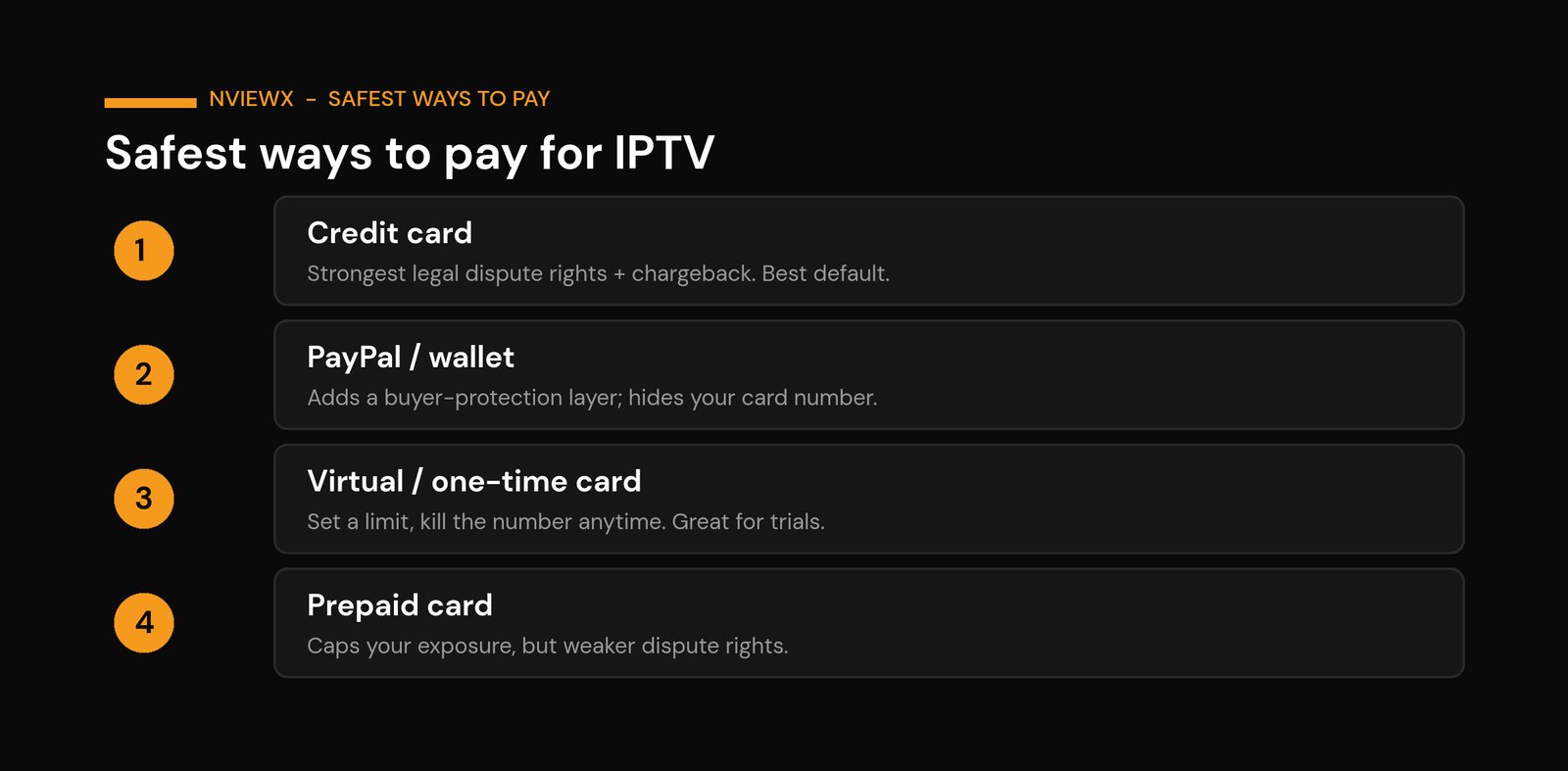
Here is how the common options stack up, roughly best to worst for buyer safety. None of this guarantees you will never have a problem — it is about which method gives you the most leverage when you do.
And the same options side by side:
| Payment method | Buyer protection | Can you reverse it? | Best for |
|---|---|---|---|
| Credit card | Strong (chargeback + legal protections) | Yes, within the dispute window | Your default for any provider |
| PayPal / wallet | Good (policy-based buyer protection) | Yes, via the wallet dispute process | Hiding your card number, extra layer |
| Virtual / one-time card | Inherits your card protections | Yes, plus you can delete the number | Free trials and untested providers |
| Prepaid card | Limited (weaker dispute rights) | Sometimes, often not | Capping how much you can lose |
| Bank / wire transfer | None | No | Avoid for unknown sellers |
| Cryptocurrency | None | No | Avoid for unknown sellers |
| Gift cards | None | No | Never – always a scam signal |
Credit card (the strong default)
A credit card is usually your best bet. If a service is not delivered or a charge is unauthorized, you can file a chargeback with your issuer, and consumer rules generally cap or eliminate your liability for fraudulent charges once you report them. You also get a longer dispute window than most other methods and a bank that will lean on the seller for you. Prefer a credit card over a debit card where you can — a debit dispute is money already gone from your account while you wait, instead of a pending charge you can contest.
PayPal or a payment wallet
A wallet adds a second layer: the seller never sees your actual card number, and the wallet has its own buyer-protection process you can open a dispute through. Funding the wallet with a credit card stacks two safety nets — the wallet’s policy plus your card’s chargeback rights. The catch: wallet buyer protection is a company policy, not a legal right, and coverage can have exclusions, so check what is actually covered before you rely on it.
Virtual or one-time card numbers
A virtual card is a disposable number tied to your real card, often with a spending limit and an expiry you control. For IPTV specifically this is a quiet superpower: set a limit that matches one billing cycle, and a seller cannot quietly charge more or auto-renew you forever. If things go bad, you freeze or delete that single number without touching your main card. It is the best tool for trials and first-time providers you are still vetting.
Prepaid card
A prepaid card caps your exposure to whatever you loaded onto it, which is a real plus. The downside is weaker dispute rights — prepaid cards do not always carry the same chargeback protections as a credit card, and some anonymous prepaid transactions are excluded from zero-liability programs. Fine as a spending cap, not great as your safety net.
Payment methods to avoid, and why
These are not “never use, ever” rules for life — crypto and bank transfers are legitimate in plenty of contexts. But for paying an IPTV seller you do not know yet, they strip away your protection, which is exactly why scammers prefer them.
- Cryptocurrency. Crypto payments are effectively irreversible — once sent, you generally only get it back if the recipient chooses to return it. A provider that takes only crypto has removed every dispute path you would otherwise have.
- Direct bank or wire transfer. Pushing money straight into someone’s account is like handing over cash. There is no chargeback, and recalling a transfer is rarely possible once it clears.
- Gift cards. No legitimate subscription business asks to be paid in gift cards. Treat any such request as a scam, full stop.
For a wider look at staying out of trouble beyond payments, see our guide on how to avoid the risks of using IPTV.
Using virtual and prepaid cards for an extra layer of safety
If you want belt-and-suspenders protection, combine methods. The pattern I would use for a provider I have not tested:
- Generate a virtual card from your bank or card app, funded by your credit card so chargeback rights flow through.
- Set a hard limit equal to one billing period, not a year. This single step kills surprise auto-renewals.
- Use it for the first cycle only. If the service is solid after a month, fine. If not, you delete the number and there is nothing left for them to charge.
- Keep the receipt and the provider’s terms. Screenshots of the offer, the price, and any refund policy are what win a dispute later.
A prepaid card works similarly as a spending cap, but remember its weaker dispute rights — pair it with caution, not blind trust. Either way, picking a provider that takes normal cards in the first place is itself a quality signal; our notes on how to choose a good IPTV provider go deeper on that, and a legal IPTV service is far more likely to offer real payment options and refunds.
Spotting payment red flags before you pay
Most bad IPTV experiences telegraph themselves at checkout. If you see these, slow down.
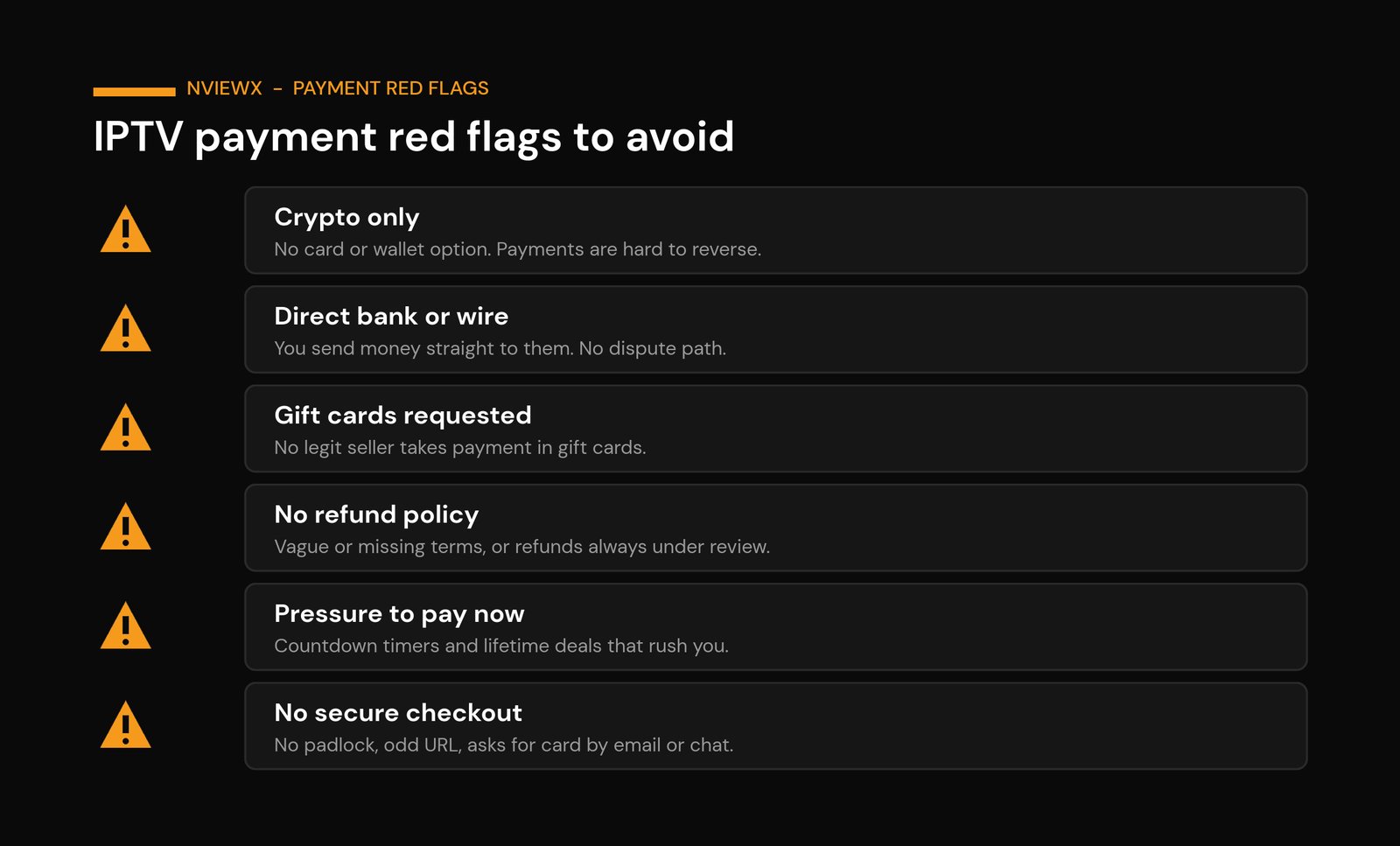
- Crypto-only or wire-only. The single biggest tell. If there is no card or wallet option at all, the seller wants your money somewhere you cannot reach it.
- No refund policy, or a vague one. Missing terms, legal word-salad, or refunds that are perpetually “under review” are designed to wear you down.
- Pressure tactics. Countdown timers, “lifetime” deals, and “only 3 left” banners exist to rush you past your own judgment.
- No secure checkout. No padlock in the browser, a mismatched or odd URL, or a seller asking for card details over email or chat instead of a real online payment page.
- A refund offered in gift cards or crypto. Real companies refund to your original payment method. The “we will refund you via gift card” line is always a scam.
What to do after a bad charge
If you have already paid and the service is dead, never worked, or the charge looks wrong, move quickly — dispute windows have deadlines.
- Contact the seller once, in writing. Ask for the service or a refund, and keep the message. A clear paper trail helps your dispute.
- Open a dispute with your card or wallet. For a credit card, call your issuer and request a chargeback; for a wallet, open a case in its resolution center. Do this within the provider’s time limit.
- Gather your evidence. The offer, the amount, dates, your message to the seller, and the refund policy you were shown. Specifics win disputes.
- Lock down the card number. If you used a virtual card, delete it. If you used a real card and suspect misuse, ask your bank to reissue it so no further charges land.
- Report it. Reporting to your local consumer-protection authority will not always recover funds, but it flags the seller and supports your case.
Frequently asked questions about safe IPTV payments
What is the safest way to pay for IPTV?
A credit card is the safest default because it gives you chargeback rights and a long dispute window. A payment wallet or a virtual card funded by a credit card adds an extra layer by hiding your real card number and letting you cap or cancel the charge.
Is it safe to pay for IPTV with crypto?
Generally no, especially with a seller you do not know. Crypto payments are effectively irreversible, so if the service fails you have no dispute path. A provider that only accepts crypto is a red flag.
Are virtual cards good for IPTV subscriptions?
Yes. A virtual card lets you set a spending limit for a single billing cycle and delete the number anytime, which stops surprise auto-renewals and limits your exposure if the provider turns out to be unreliable.
Can I get my money back after paying for a bad IPTV service?
If you paid by credit card or a wallet, you can usually open a dispute or chargeback within the provider’s time limit. Keep your receipt, the offer details, and any messages with the seller as evidence. Money sent by crypto, wire, or gift card is very hard to recover.
Why do some IPTV sellers only accept bank transfer or crypto?
Because those methods remove your ability to reverse the payment. Legitimate sellers benefit from offering cards and wallets; sellers who avoid them often do so to dodge disputes and refunds.
Is a prepaid card safer than a credit card for IPTV?
A prepaid card limits how much you can lose to the amount loaded, which is useful. But it usually has weaker dispute rights than a credit card, so it is a good spending cap rather than your main safety net.
What payment red flags mean an IPTV provider is a scam?
Crypto-only or wire-only checkout, no clear refund policy, heavy pressure tactics, no secure padlocked checkout page, and any request to pay or be refunded in gift cards. Any one of these is reason to walk away.
Pay smart, stream worry-free. If you would rather skip the guesswork, Nviewx focuses on doing things the safe, above-board way — clear options and no shady checkout tricks. See what a good provider looks like before you pay anyone.
This article is general consumer-safety information, not financial or legal advice. Payment protections vary by card issuer, wallet, and country — check your own provider’s terms and your local consumer-protection rules for your exact rights.