Skip to content
How to Get a Good IPTV Provider in 2026
A good IPTV provider is one that stays up when everyone wants to watch at once, answers you when something breaks, takes payment through a method you can dispute, and lets you test the service before you hand over money. That is the whole job in one sentence. Everything else — the channel-count bragging, the slick homepage, the “lifetime” deal — is noise until those four things check out.
Most people pick a provider the way they pick a restaurant from a glowing photo, then act surprised when the stream freezes during the one match they actually cared about. This guide is about doing the opposite: how to read a service the way someone who has been burned a couple of times reads it. No provider names, no shortcuts — just the signals that separate a service worth paying for from one that vanishes with your card details.
One note before we start. Choosing a provider is not the same as choosing a player. If you want help picking the app that displays the stream, that is a separate decision — see our guide to the best IPTV app. Here we are only talking about the service behind the app: the company, the servers, the support, and the money.
What actually makes a provider “good”
Strip away the marketing and a good IPTV provider comes down to four pillars. If a service is weak on any one of them, the other three rarely save it.
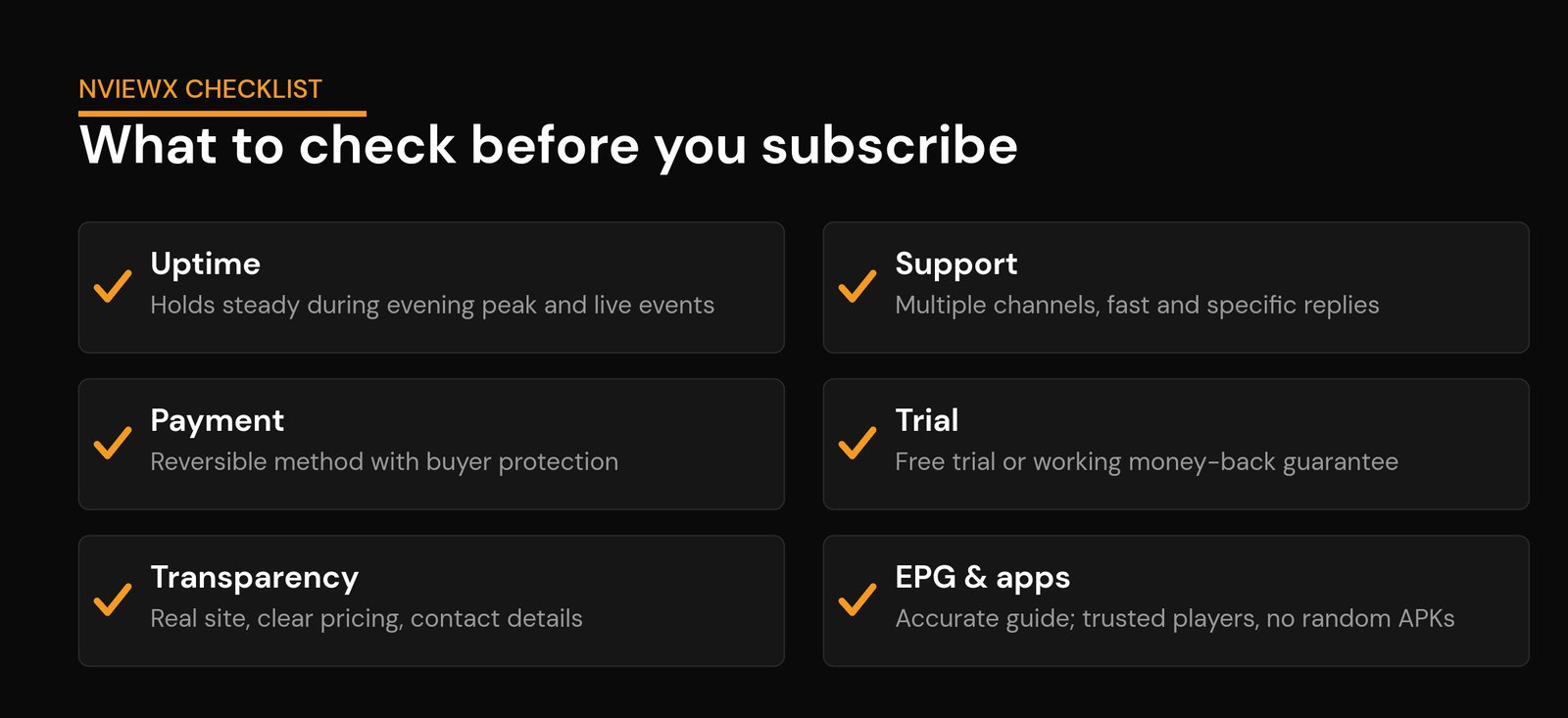
- Reliability and uptime. The stream holds during peak hours and big live events, not just on a quiet weekday afternoon.
- Support that responds. A real human (or at least a real ticket system) answers within hours, not days, and actually fixes things.
- Safe, transparent payment. You can pay with a method that offers buyer protection, and the pricing has no hidden surprises.
- A way to test first. A free trial or a genuine refund policy lets you verify all of the above before you commit.
Notice what is not on that list: a giant channel number, a flashy interface, or a rock-bottom price. Those can be nice, but they are easy to fake and they tell you nothing about whether the service will still work next month. IPTV as a delivery method is only as good as the infrastructure and people behind it.
Reliability and uptime: the test that matters
Uptime is the single biggest predictor of whether you will be happy. The catch is that almost every service looks fine at 2pm on a Tuesday. The real test is the evening rush — roughly 7–11pm local time — and during major live events, when thousands of people hit the same servers at once. That is the moment overloaded infrastructure either holds steady or falls apart.
When you evaluate a provider, look for these reliability signals:
- A stated uptime target. Serious operators publish something like 99% or 99.9% uptime and back it with real server capacity. A formal service-level agreement (SLA) is a strong sign you are dealing with a real business, not a hobbyist.
- Server load and buffering behaviour. Persistent buffering in the evenings means the provider oversold its capacity. A stream that holds 1080p at 9pm during a busy live broadcast is telling you the infrastructure is real.
- Server location and latency. Servers far from you add latency and stutter. A provider with nodes near your region will almost always feel smoother.
- Honest channel claims. “20,000+ channels” usually means a list padded with dead links and duplicates. A smaller, well-maintained lineup beats a huge broken one every time.
You cannot measure most of this from a sales page, which is exactly why the trial (below) matters so much. But you can rule out the worst offenders by reading how a provider talks about its servers. Vague hype (“blazing fast, never buffers!”) is a worse sign than a plain technical description of how the network is built.
Support that actually matters
Streams go down. Logins expire. An app stops talking to the server after an update. None of that is a dealbreaker — what matters is whether someone helps you fix it. Support is where the gap between a real service and a fly-by-night reseller shows up fastest.
Good support has a few tells. There is more than one way to reach them — a ticket system, email, or live chat on an actual website, not just a single anonymous chat handle. Replies arrive in hours, not “sometime.” And the answers are specific: a real agent will ask what device and player you are using, what the error says, and walk you through it, rather than pasting the same canned reply to everyone.
Test this before you pay. Send a pre-sales question — ask about device compatibility, or how they handle an outage — and time the response. A provider that ignores you while it still wants your money will not get faster once it already has it. If the only contact channel is a messaging app with no website behind it, treat that as a hard stop.
Safe and transparent payment
How a provider takes your money is one of the most honest signals it gives off, because it reveals how accountable the operator is willing to be. The principle is simple: pay with a method you can dispute.
- Reversible methods are best. Credit cards and established payment processors give you buyer protection — if the service disappears, you have a path to a chargeback.
- Crypto-only is a warning. A provider that only accepts cryptocurrency has deliberately removed every avenue for you to claw money back. Some legitimate services offer crypto as an option, but “crypto or nothing” usually means the operator plans to stay untraceable.
- Transparent pricing. The total should be clear up front — the renewal price, the billing cycle, any setup fee. Hidden charges that appear after you sign up are a pattern, not an accident.
- Be very wary of “lifetime” deals. A one-time payment for permanent access is not how a recurring streaming business funds its servers. Cheap lifetime offers ($50–$100 for “forever”) are among the most common ways people lose money, because the service simply vanishes once enough payments roll in.
If you are weighing whether a service is even operating on the right side of the line, our breakdown of how to get a legal IPTV service walks through the legitimacy signals in more detail.
Free trials and refunds: test before you trust
This is the step that protects you from everything above, and the one most people skip. A reputable provider gives you a way to verify the service risk-free — either a genuine free trial (commonly 24–48 hours, no payment required) or a money-back guarantee (you pay, then can request a refund).
Those two are not the same thing, and the difference matters. A free trial needs no card up front; a money-back guarantee requires you to pay first and trust that the refund process actually works. A free trial is the lower-risk option. If a provider offers neither, that absence is itself the answer — a service confident in its quality is happy to let you test it.
When you get a trial, do not just glance at it at lunchtime. Run it properly:
- Watch during the evening peak (7–11pm), when servers are under the most load.
- Tune in to a live broadcast if one is on — live streams stress the network far more than on-demand.
- Check the EPG (the on-screen guide): does it show accurate programming several days ahead, or is it blank and stale?
- Flip between your most-watched channels and watch for start-up delay, freezing, and resolution drops.
- Confirm it works on the device you actually use — Firestick, Android TV, a Smart TV app, whatever it will be.
Once you have a provider you trust, the next steps are practical: see how to set up IPTV and, for the most common streaming box, our walkthrough on how to install IPTV on a Firestick.
Red flags that should end the conversation
Some signals are not “be careful” — they are “walk away.” If you spot any of these, stop, regardless of how good the price looks.
- No website, only a chat app. A trial promoted purely through an anonymous messaging handle, with no professional site behind it, is the classic reseller pattern — informal on purpose, so it can disappear.
- Trial credentials sent by hand. Legitimate services issue trial logins automatically and instantly. A person manually messaging you details points to a tiny, unaccountable operation.
- “Install this APK from our link.” Real providers point you to apps in official stores. A sideloaded file from an unknown link can carry malware. Stick to trusted players.
- Hidden ownership. No company details, no real contact info, and a URL that keeps changing all point to an operator that does not want to be found.
- Crypto-only payment. Covered above — the absence of any reversible payment method is deliberate.
- Impossible promises. “Every channel on earth,” “never buffers, guaranteed,” and ultra-cheap lifetime access are sales hooks, not features.
- Suspiciously cheap. Running real servers costs money. A price far below everyone else usually means oversold, overloaded infrastructure — or a plan to take the cash and vanish.
Good provider vs. risky provider, side by side
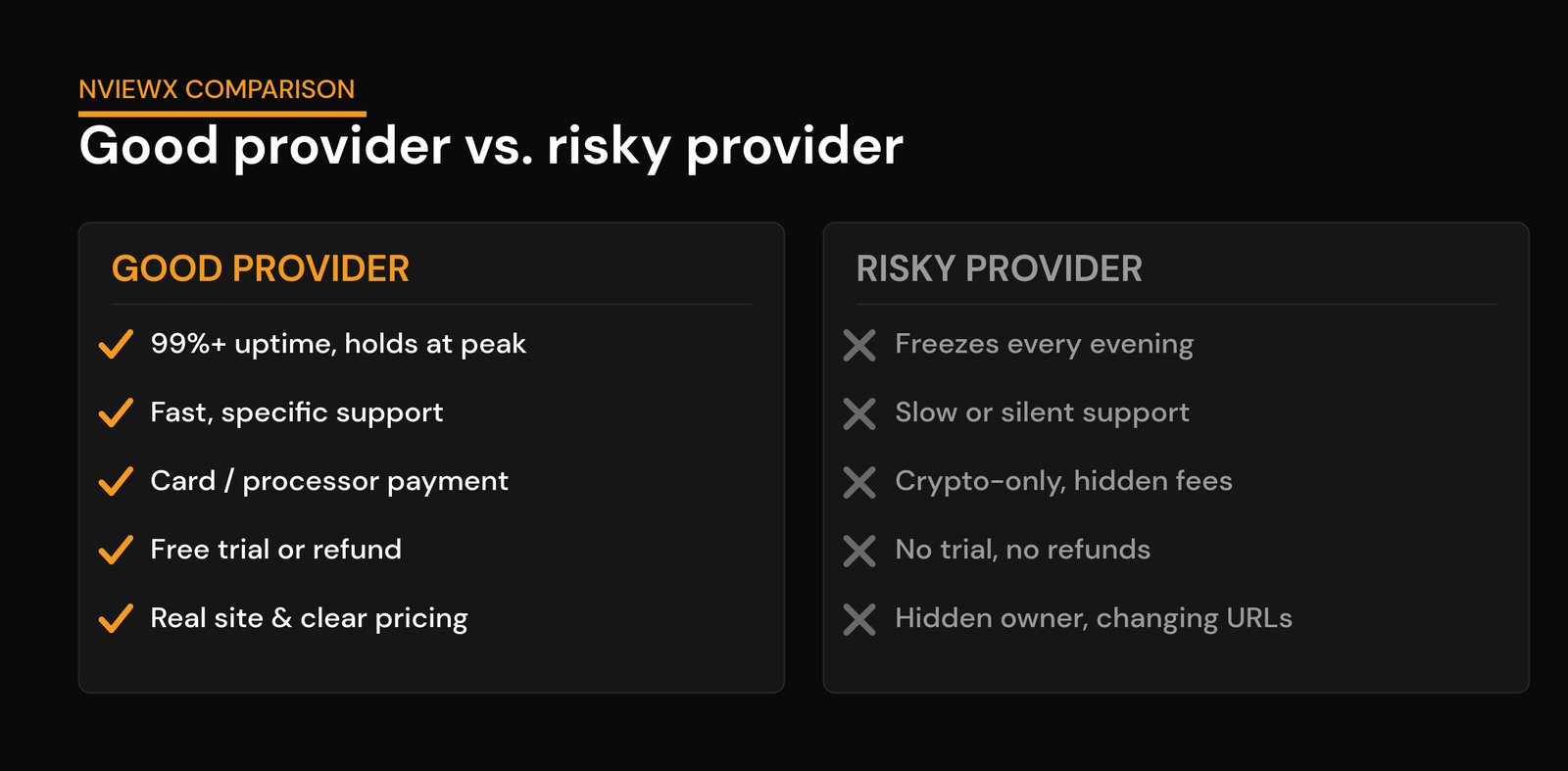
Here is the same set of signals laid out as a quick comparison. Use it as a checklist while you shortlist services.
| Signal | Good provider | Risky provider |
|---|---|---|
| Uptime | Stated target (99%+), holds during peak and live events | No commitment; freezes every evening |
| Support | Multiple channels, replies in hours, specific answers | One anonymous chat handle, slow or silent |
| Payment | Card / processor with buyer protection, clear pricing | Crypto-only, hidden fees, “lifetime” deals |
| Trial / refund | Free trial or working money-back guarantee | No trial, no refunds, pay first and hope |
| Transparency | Real website, contact details, terms of service | Hidden owner, changing URLs, vague claims |
| Apps | Works with trusted players from official stores | Pushes an unknown APK via a link |
A simple way to put it all together
Shortlist two or three services that pass the paper test — real website, clear pricing, reversible payment, a stated uptime figure, and a trial or refund. Then let the trial decide. Watch in the evening, push a live broadcast through it, fire a question at support, and check the guide. Whichever one holds up under that pressure is your provider. The one that buffers, ignores your message, or only wants crypto has already told you what you needed to know.
If you are still getting your bearings on the technology itself, our explainer on what an IPTV service is and the one on what Xtream Codes are will fill in the background.
Frequently asked questions
What is the single most important sign of a good IPTV provider?
Reliability during peak hours. A service that streams cleanly at 9pm and during a busy live event has the server capacity that everything else depends on. That is why a proper trial — watched in the evening, not at lunchtime — tells you more than any sales page.
Should I trust a provider that only accepts cryptocurrency?
Be very cautious. Crypto is non-reversible, so a crypto-only service has removed your ability to dispute a charge if it disappears. Some legitimate providers offer crypto as one option among several, but “crypto or nothing” is a common pattern with operators who plan to stay untraceable. Prefer a method with buyer protection.
Are “lifetime” IPTV subscriptions worth it?
Almost never. Running servers is an ongoing cost, so a one-time payment for permanent access does not add up for a real business. Cheap lifetime deals are one of the most common ways people lose money — the service collects payments and then vanishes. Pay per month or per year with a provider you can hold accountable.
How long should a free trial be, and how do I use it?
Anywhere from a few hours to 48 hours is normal. Use it during the evening peak, push a live broadcast through it, check that the on-screen guide (EPG) is accurate several days ahead, and confirm it runs on the device you will actually use. Watch for start-up delay, freezing, and resolution drops.
What is the difference between a free trial and a money-back guarantee?
A free trial needs no payment up front — you test, then decide. A money-back guarantee means you pay first and request a refund later, which depends on the refund process actually working. A free trial is the lower-risk option, but a genuine money-back guarantee from a transparent provider is still far better than no test at all.
How fast should customer support respond?
Within hours during normal operating times, and the answer should be specific to your device and the error you described. Test it before you buy by sending a pre-sales question. If they are slow or silent while they still want your money, that will not improve after you pay.
Is a higher channel count a sign of a better provider?
No. Huge numbers like “20,000+ channels” are usually padded with dead links and duplicates. A smaller, well-maintained lineup that actually works beats a giant broken one. Judge a service by whether your channels load reliably, not by the total it advertises.
How can I tell if a provider is a legitimate business?
Look for a real, well-built website with clear pricing, terms of service, and contact details; reversible payment options; and responsive support. Hidden ownership, frequently changing URLs, and vague language are warning signs. For a deeper look at legitimacy, see our guide on getting a legal IPTV service.
Picking the right service is the part that saves you money and headaches — take the trial seriously and let the evening rush make the decision for you. For more practical, no-hype guides on setup, devices, and staying safe, keep reading here on Nviewx.