Skip to content

IPTV Laws by Country: Is It Legal Where You Live? (2026)
IPTV laws by country almost always come down to one thing, and it isn’t the app on your screen — it’s where the stream comes from. The technology itself is legal everywhere. IPTV is just live TV delivered over the internet instead of a satellite dish or cable line, and plenty of licensed broadcasters and telecom companies use it. What changes from one country to the next is how the law treats unlicensed streams of paid content, who gets punished, and how hard the authorities push.
So the short answer to “is IPTV legal where I live?” is: watching a properly licensed service is legal in every country on this list. Watching an unlicensed one is a copyright problem almost everywhere — the difference is only in the penalties and how actively they’re enforced. Here’s how that plays out region by region in 2026.
The one rule behind every country’s IPTV law
Before the country-by-country breakdown, get this straight because it explains all of it. A stream is either licensed or it isn’t.
A licensed service has paid the content owners — the studios, the leagues, the broadcasters — for the right to show their channels. An unlicensed service hasn’t. It grabs those feeds and resells them cheaply, which is copyright infringement in essentially every country that signed the international copyright treaties (that’s almost all of them). The suspiciously cheap “all channels, all sports, all movies for a few dollars a month” offer is the classic tell of an unlicensed operation.
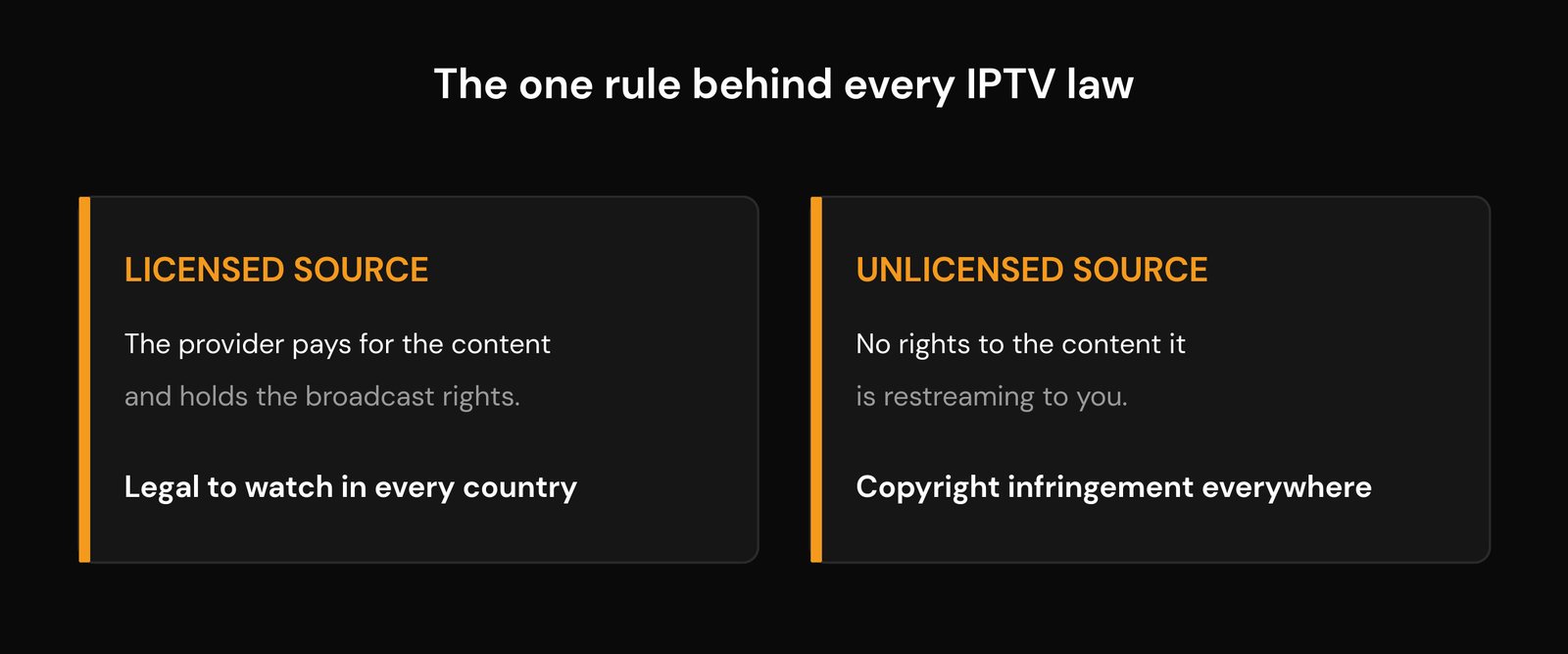
This is why you can’t judge legality by the player app. The same app can load a legitimate subscription or a pirated playlist, and the law only cares about the second part. If you’re still fuzzy on the basics, our guide to what an IPTV service actually is covers the plumbing.
IPTV laws by country: a quick comparison
This table sums up the legal picture in the places people ask about most. “Watching a licensed service” is legal in all of them; the columns that change are how unlicensed streaming is treated and where enforcement points.
| Region | Unlicensed streaming is treated as | Main enforcement focus |
|---|---|---|
| United States | Federal copyright violation; commercial streaming can be a felony | Operators and sellers |
| United Kingdom | Criminal copyright offence; up to 10-year sentences for suppliers | Sellers, plus warnings to buyers |
| European Union | Infringement — even watching from an obviously illegal source | Operators; live stream-blocking |
| Canada | Civil infringement; “notice-and-notice” warnings to users | Operators; site-blocking orders |
| Australia | Infringement; heavy reliance on ISP site-blocking | Domains and operators |
| Middle East & Gulf | Illegal; some of the toughest anti-piracy penalties | Operators, sellers, and users |
| Most of the rest | Infringement on paper; enforcement varies widely | Usually operators, if anyone |
Laws change and this is a general summary, not legal advice — check your own country’s current rules if you need certainty. For the wider legal reasoning behind all of this, see our explainer on whether IPTV is legal.
United States: the DMCA and the streaming felony law
In the U.S., unlicensed streaming breaks copyright law under the Digital Millennium Copyright Act. For years, illegal streaming was only a misdemeanour, which made big pirate operations hard to prosecute. That changed with the Protecting Lawful Streaming Act, signed in late 2020, which lets the Department of Justice bring felony charges against people who run commercial illegal-streaming services for profit.
The key word there is commercial. The law was written to go after the operators and sellers, not the person at home clicking play. American viewers are extremely unlikely to be prosecuted for watching, but they are still using an illegal service, and the payment side carries its own risk — handing card details to an anonymous pirate seller is how people end up with mystery charges on their statement.
United Kingdom and Europe: aggressive on sellers
The UK is one of the most active places in the world on this. Supplying access to unlicensed streams is a criminal offence, and people who sell subscriptions or preloaded boxes have received prison sentences of several years. Maximum penalties for online copyright infringement run up to ten years. Buyers aren’t the main target, but rights holders do send warning letters, and courts grant “live blocking” orders that knock pirate streams offline in real time during big events.
Across the wider European Union, a landmark Court of Justice ruling settled a question many people still get wrong: streaming copyrighted material from a source you know is illegal is itself infringement, not a loophole. It doesn’t matter that you never downloaded a file. Individual member states set their own penalties — some are strict, some barely enforce against viewers — but the legal principle is consistent across the bloc.
Canada and Australia: notices and site-blocking
Canada leans on a “notice-and-notice” system. Rights holders spot an infringing connection and, by law, your internet provider must forward the warning notice to you. Ignoring a stack of those isn’t wise, since copyright owners can take civil action. Courts have also ordered ISPs to block known pirate IPTV domains.
Australia is the site-blocking capital. Rather than chase individual viewers, rights holders get Federal Court orders forcing internet providers to block pirate services at the network level, and the block-lists are updated constantly. You’ll usually notice enforcement as a stream that simply stops resolving, not as a knock on the door.
Middle East, Asia, and everywhere else
Several Gulf and Middle Eastern countries have some of the harshest anti-piracy regimes anywhere, with penalties that can reach users, not just sellers, and fast domain-blocking. Parts of Asia enforce hard around major live events and go quiet the rest of the year. In much of the rest of the world, unlicensed streaming is technically illegal because of international copyright treaties, but everyday enforcement against viewers is light to non-existent.
The takeaway isn’t “it’s fine here.” It’s that “nobody I know got in trouble” is about enforcement, not legality — and enforcement can change fast when a broadcaster starts pushing.
What viewers actually risk versus sellers
Almost every scary IPTV headline is about someone who ran a service or resold subscriptions, not someone who watched one. It helps to separate the tiers.
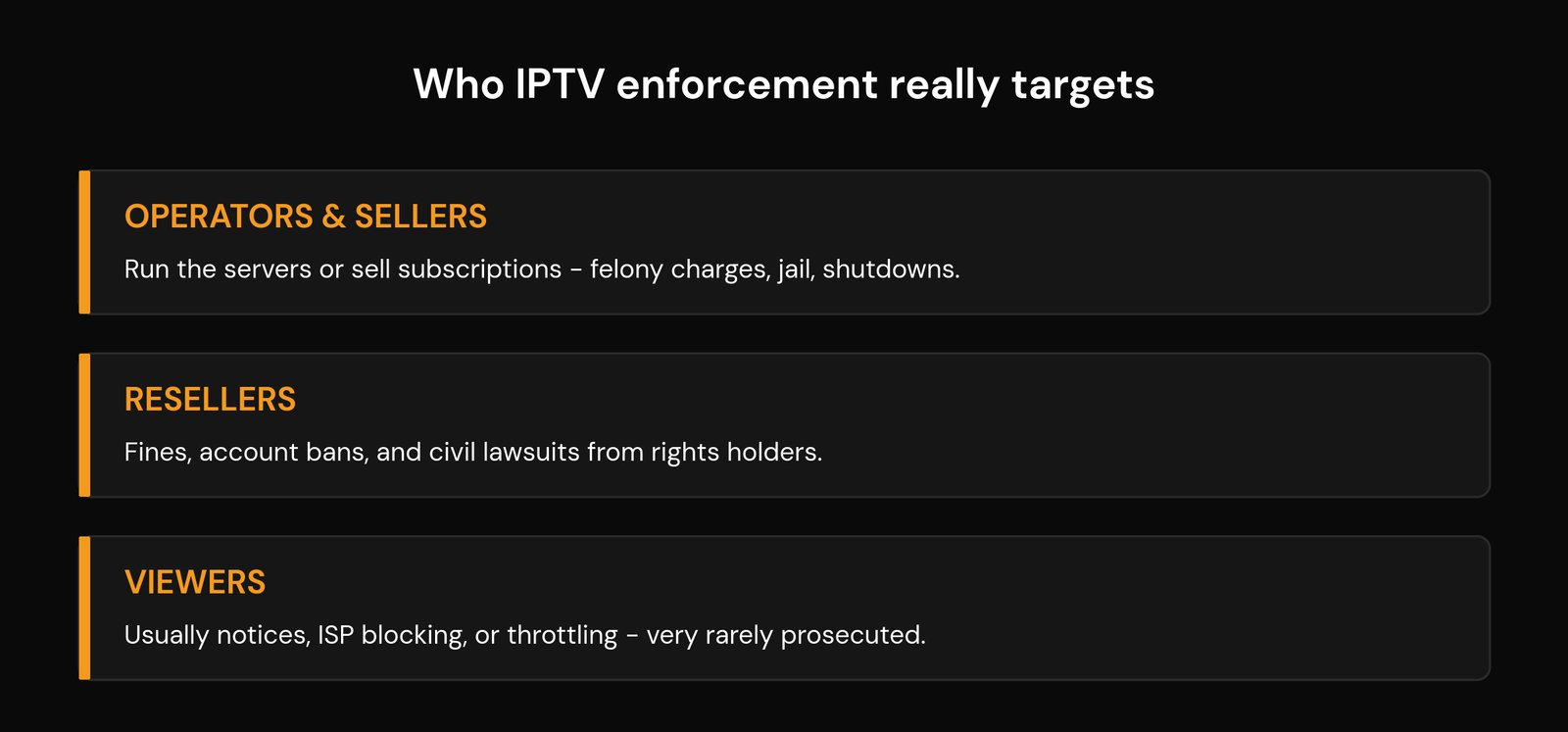
Operators and sellers sit at the top of the risk pile: felony charges, raids, and prison in the strictest countries. Resellers — the people flipping subscriptions in group chats — face fines, account bans, and civil lawsuits. Viewers are at the bottom: in most countries the realistic outcomes are a warning notice, a stream that gets blocked, or your provider throttling the connection once it spots heavy streaming. Prosecution of ordinary viewers is rare, though not impossible in the toughest jurisdictions.
None of that makes an unlicensed service legal — it just explains why the consequences land where they do.
How to stay on the right side of IPTV law
The clean way to enjoy IPTV without gambling on your local enforcement mood is to keep the “licensed source” box ticked. A few habits do most of the work:
- Use a legitimate provider. If the price is far below what the content is worth and nobody can explain where the rights come from, treat it as a red flag. Our guide to choosing a legal IPTV service walks through the checks.
- Learn the scam signals. Unlicensed and outright fraudulent services overlap a lot. The 10 red flags of a fake IPTV service will save you money and hassle.
- Protect your privacy and payments. Whatever you watch, don’t hand card numbers to anonymous sellers, and understand what your provider can see. Some people add a VPN for privacy, though a VPN changes what your ISP sees — it doesn’t make an illegal stream legal.
Frequently asked questions
Is watching IPTV illegal in my country?
Watching a licensed IPTV service is legal in every country covered here. Watching an unlicensed one is copyright infringement almost everywhere; what varies is the penalty and how actively viewers are pursued, which ranges from “essentially never” to “possible fines” in the strictest places.
Can I go to jail for watching an illegal stream?
For simply watching, that’s very unlikely in most countries — jail time is aimed at the people who run and sell the services. A small number of the toughest jurisdictions do reach individual users, so the honest answer is “almost never, but not guaranteed nowhere.”
Does using a VPN make IPTV legal?
No. A VPN changes what your internet provider can see about your traffic, but it doesn’t give an unlicensed service the rights it’s missing. Legality depends on the source of the stream, not on whether you hide the connection.
How do authorities usually enforce IPTV laws?
Mostly by going after operators and by ordering internet providers to block pirate domains, so the common viewer-facing sign is a stream that stops working rather than a legal letter. Some countries also send copyright warning notices through your ISP.
How can I tell if an IPTV service is licensed?
Licensed services are transparent about the company behind them and priced in line with the content they carry. If an offer bundles essentially everything for a few dollars a month with no verifiable company details, it’s almost certainly unlicensed.