Skip to content

Fake IPTV Service? 10 Scam Red Flags to Check (2026)
A fake IPTV service takes your money and never delivers what it promised: the stream dies after a few days, the “lifetime” plan quietly disappears, or the whole website is gone the moment you ask for help. The good news is that almost every scam shows its hand before you pay. Below are the 10 red flags that separate a real provider from a fake one, a quick checklist you can run in about five minutes, and exactly what to do if you have already handed over your card details.
This is not about whether streaming is legal or worthwhile — that is a separate question we cover in our guide on getting a legal IPTV service the safe way. This page is only about spotting a dishonest seller so you do not lose money.
What is a fake or scam IPTV service?
A fake IPTV service looks like an ordinary provider from the outside: a slick homepage, a long channel list, a checkout page. The streaming part itself is just ordinary internet-delivered television, so that is not where the trick lives. The scam is in the selling — taking payment for a service the seller cannot or will not actually provide. Some collect your cash and vanish. Others run for a few weeks, then oversell their servers until the picture freezes every evening. A few are really after your card number and email, not your subscription fee at all. It is a classic confidence trick dressed up in a streaming theme.
Legitimate providers exist too, and they tend to behave in predictable, boring, trustworthy ways. Once you know what normal looks like, the fakes stand out fast.
10 red flags that an IPTV service is a scam
No single flag is proof on its own, but if a service trips two or three of these, walk away. Here is the quick side-by-side, then the detail.
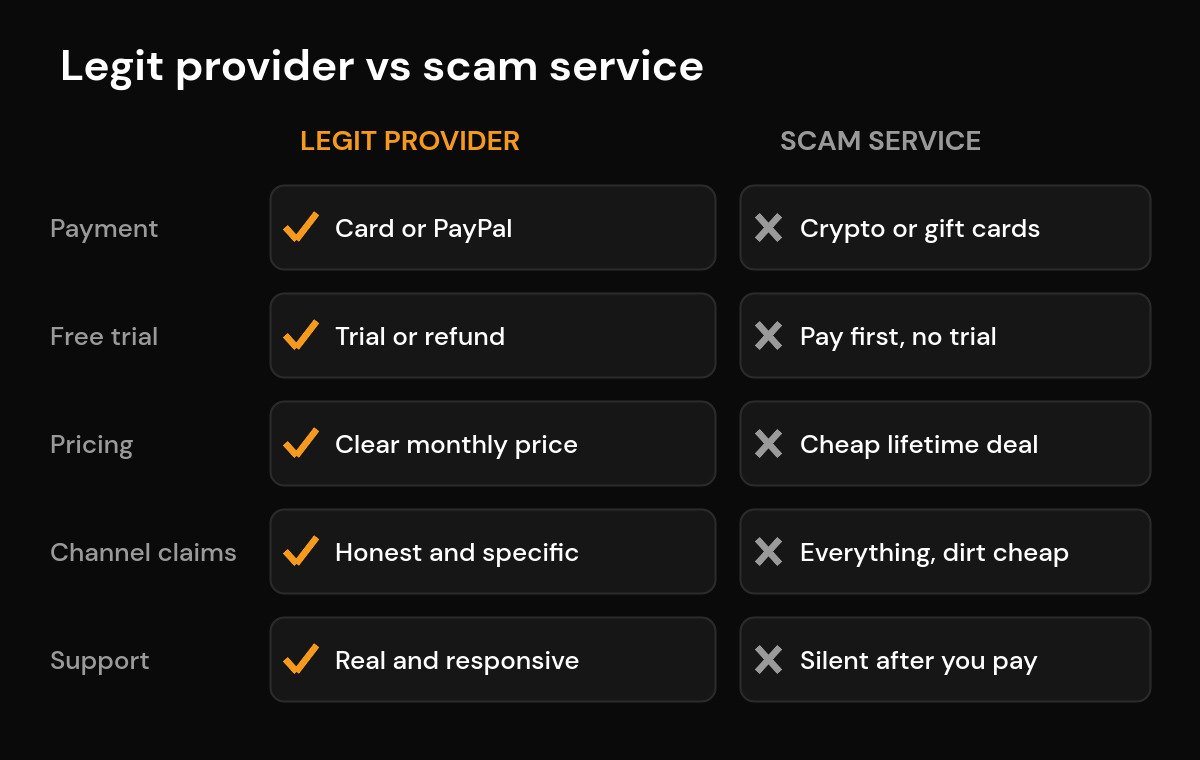
| Signal | Real provider | Likely scam |
|---|---|---|
| Payment methods | Card, PayPal, or other disputable options | Crypto, gift cards, or bank transfer only |
| Free trial | Trial or short refundable plan | Pay in full first, no trial |
| Pricing | Clear monthly or yearly price | Cheap one-off “lifetime” deal |
| Channel claims | Specific and realistic | Everything imaginable, dirt cheap |
| Reviews | Found on independent sites | Only on their own website |
| Support and uptime | Responsive, stable at peak times | Silent when it matters |
1. Crypto or gift cards are the only way to pay. Real businesses want repeat customers, so they accept methods you can dispute — a card or PayPal. If a seller insists on cryptocurrency, gift cards, or a direct bank transfer, they are choosing payment rails you can never claw back. That is the single biggest tell. Our guide to safe IPTV payment methods goes deeper here.
2. No free trial and no refund policy. A provider confident in its servers will let you test first, or at least offer a short, cheap plan with a written money-back guarantee. “Pay for a full year up front, no trial” is how a fake avoids letting you see the product before the money is gone. Learn how to use a free trial properly before you commit.
3. A cheap “lifetime” subscription. Running streaming servers costs money every single month. Nobody funds that with one small one-off payment, so a “lifetime” deal almost always means one of two things: the seller plans to take the cash and close, or the service will be unusable within months.
4. “Every channel in the world” for a few dollars. Honest providers are specific about what they carry. A scam overpromises — tens of thousands of channels, every premium package, all the live sports and every big event, all for pocket change. If the offer sounds impossible, it is.
5. Reviews only exist on their own website. Fake glowing testimonials are easy to write. Search the brand name on independent forums and review sites. If the only praise lives on the seller’s own pages — or every review reads like the same person wrote it — treat it as unverified.
6. The website is sloppy or brand new. Broken links, spelling mistakes, stock photos, and a domain registered a few weeks ago are all warning signs. It costs a scammer nothing to spin up a fresh site after the last one was reported.
7. High-pressure sales tactics. Countdown timers, “only 3 spots left,” and constant discount pop-ups are designed to stop you thinking. A real subscription will still be there tomorrow. Urgency is a manipulation tool, not a deal.
8. They go silent when you need support. Message their support with a simple question before you buy. A real provider answers. A scam either ignores you or sends a canned reply, and it goes quiet the instant the stream breaks or you mention a refund.
9. They ask you to disable device security. If setup instructions tell you to switch off your phone or TV security, grant strange permissions, or install an app from a link they send rather than a normal app store, stop. That is how malware gets on your device.
10. No real company details anywhere. No business name, no contact address, no consistent brand across their social pages — just a checkout button. Legitimate sellers leave a trail you can follow; scammers hide.
A safe-buying checklist before you pay
Run through this quick list before you enter any card details. It takes about five minutes and filters out the vast majority of fakes.
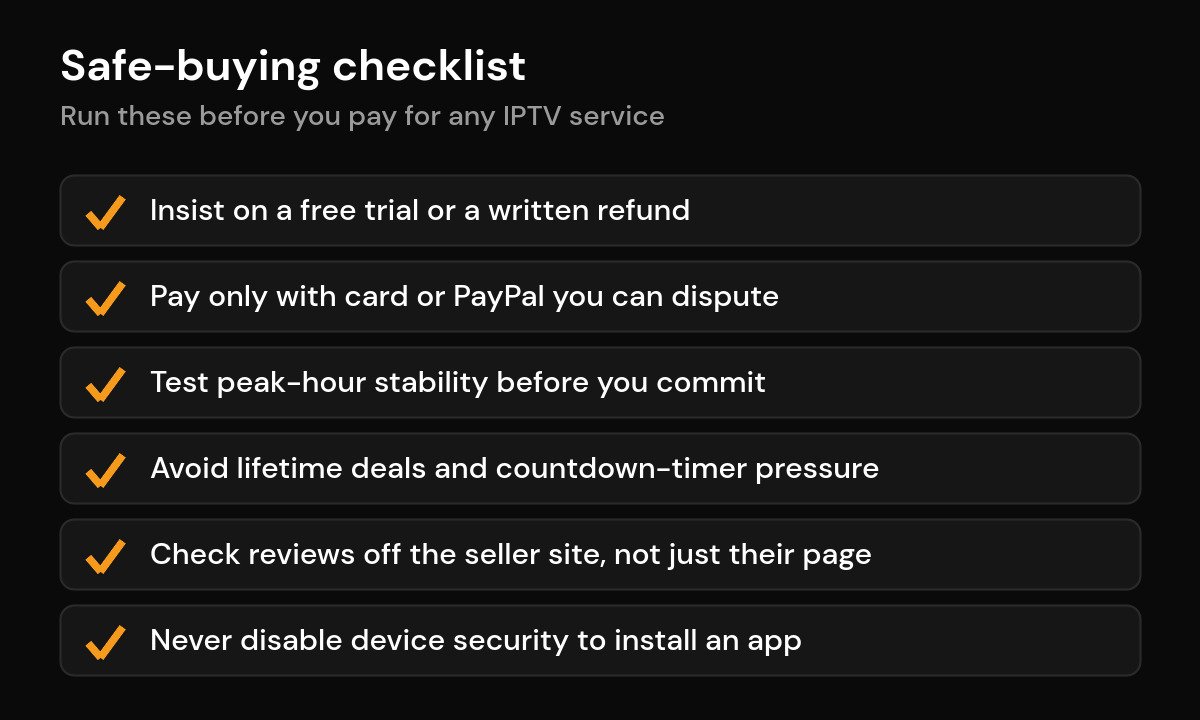
| Step | Why it matters |
|---|---|
| Insist on a free trial or written refund | Lets you see the product before the money is gone |
| Pay only with card or PayPal | You can dispute the charge if it goes wrong |
| Test peak-hour stability yourself | Fakes fall apart during the evening rush |
| Avoid lifetime deals and pressure offers | Ongoing servers need ongoing payment |
| Check reviews off their own site | Independent feedback is much harder to fake |
| Never disable device security | Protects you from malware in a sideloaded app |
If a service passes every line above, you are in good shape. If it fails even one of the payment or trial checks, keep looking — there is no shortage of providers, and our guide on how to choose a good IPTV provider shows what a solid one looks like.
What to do if you already paid a fake IPTV service
If the penny has just dropped, act quickly — the sooner you move, the better your odds of getting money back.
- Start a dispute or chargeback. If you paid by card or PayPal, contact your provider and request a chargeback, explaining the service was not delivered as described. Card networks usually give you a window of several weeks, so do not wait.
- Watch your statement. Scammers sometimes bill you again later or pass your details on. Check for unauthorized IPTV charges and set up transaction alerts.
- Change any reused password. If you made an account with a password you use elsewhere, change it everywhere. Never reuse passwords across sites.
- Scan the device. If you installed anything they sent you, remove it and run a security scan. Our guide on avoiding IPTV risks covers the cleanup.
How to find a genuine provider instead
Avoiding scams is only half the job; you still want something that actually works. Stick to providers that let you test before you pay, accept disputable payment, and are honest about what they offer. From there:
- Use a free trial or short paid plan to test peak-hour stability yourself.
- Pay only with a method you can dispute.
- Follow a simple provider checklist so you know what good looks like.
- If privacy matters to you, read whether you need a VPN for IPTV.
Frequently asked questions
How can I tell if an IPTV service is fake before I pay?
Check how they take payment and whether they let you test first. A real provider accepts a card or PayPal and offers a trial or refund; a fake pushes crypto or gift cards, skips trials, and dangles a cheap lifetime deal. Two or three of those together is your cue to walk away.
Are cheap lifetime IPTV subscriptions a scam?
Almost always. Streaming servers cost money every month, so a one-off lifetime fee cannot fund them for long. In practice the service either shuts down once enough people have paid, or degrades until it is unwatchable. Treat lifetime pricing as a red flag, not a bargain.
Is it safe to pay for IPTV with a credit card or PayPal?
It is safer than untraceable methods, because a card or PayPal payment can be disputed if the service is not delivered. The bigger risk is entering card details on a sketchy checkout page, so only pay a seller that has passed the other checks in this guide, and watch your statement afterwards.
What should I do if I already paid a fake IPTV service?
Request a chargeback or dispute through your card or PayPal straight away, explaining the service was not delivered. Change any password you reused on their site, remove anything you installed, and monitor your statement for repeat or unauthorized charges.
Do scam IPTV services steal your personal data?
Some do. The main risks are your payment details and any password you reuse, plus malware if you install an app from a link they send instead of a normal app store. Use a throwaway email, never disable device security to install something, and keep payments to disputable methods.