Skip to content


IPTV for Business: The Legal Rules for Bars & Gyms
Using IPTV for business is not the same thing as watching at home, and that single sentence is where most venue owners get caught out. A home subscription — any home subscription, from any provider — gives you the right to watch privately. The moment that same screen faces a room the public can walk into, you have moved from private viewing into what copyright law calls a public performance, and that needs a different, usually more expensive, set of rights.
This guide covers what actually changes when a stream moves from your living room to a bar, gym, hotel lobby, barber shop or waiting area: which rules apply, why the old “small business TV exemption” almost never rescues a streaming setup, what a legitimate commercial arrangement looks like, and what tends to happen when a venue gets it wrong. It is general information rather than legal advice — venue rules vary a lot by country, and a licensing lawyer in your jurisdiction is worth an hour of their fee.
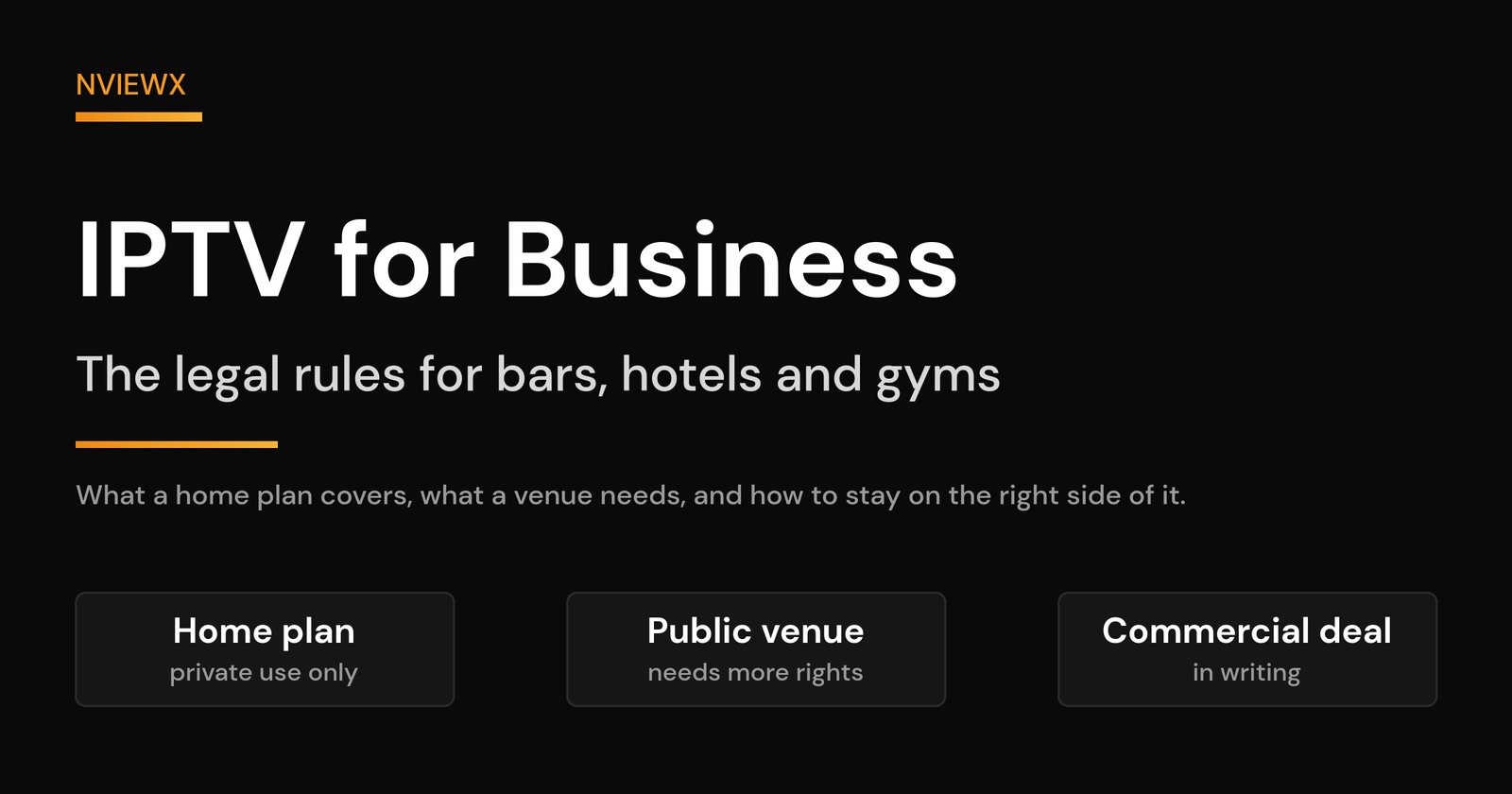
The short answer: a home plan does not cover a public room
Every consumer streaming subscription — cable, satellite, on-demand app, or IPTV — is sold under terms that limit it to private, non-commercial, household use. That is not fine print nobody enforces; it is the entire basis on which the rights were licensed to the provider in the first place. Rights holders sell “residential” rights and “commercial” rights separately, and they price them very differently, because a bar with sixty people watching a big event is worth far more to them than one household.
So the practical rule is short: if people who are not part of your household can see the screen, you need permission that a home plan does not give you. That applies whether the source is an aerial, a satellite dish, a cable box, a streaming app, or an IPTV service. The delivery technology is irrelevant to the law. What matters is who is watching and where.
If you are still working out the basics of where consumer IPTV sits legally, start with our explainer on whether IPTV is legal — this guide picks up where that one stops.
What “public performance” actually means
Copyright gives the owner of a work several separate rights, and one of them is the exclusive right to perform or communicate that work to the public. In the United States this sits in the Copyright Act of 1976; across the EU and UK it appears as the “communication to the public” right; the underlying idea is the same almost everywhere thanks to a shared treaty framework. These are usually administered and enforced through performing rights bodies and rights-holder agents rather than by the creators themselves.
“Public” is broader than most people assume. It does not require an admission fee, an audience, or even anyone actually watching. Courts have generally treated a place as public if it is open to people beyond a normal circle of family and social acquaintances. That sweeps in:
- bars, cafes, restaurants and takeaways
- gyms, studios and leisure centres
- hotel lobbies, bars, gyms and (in many countries) guest rooms
- salons, barbers, tattoo studios and clinics
- waiting rooms, showrooms, dealerships and reception areas
- staff canteens and break rooms in larger workplaces
- student halls, care homes and other communal residential spaces
It also does not matter that you are not charging for it. “We just have it on in the background” is the single most common defence venue owners offer, and it is not a defence at all. Nor is muting the sound; the picture is the licensed thing.
Home versus business: what actually changes
The stream looks identical. The rights attached to it do not.
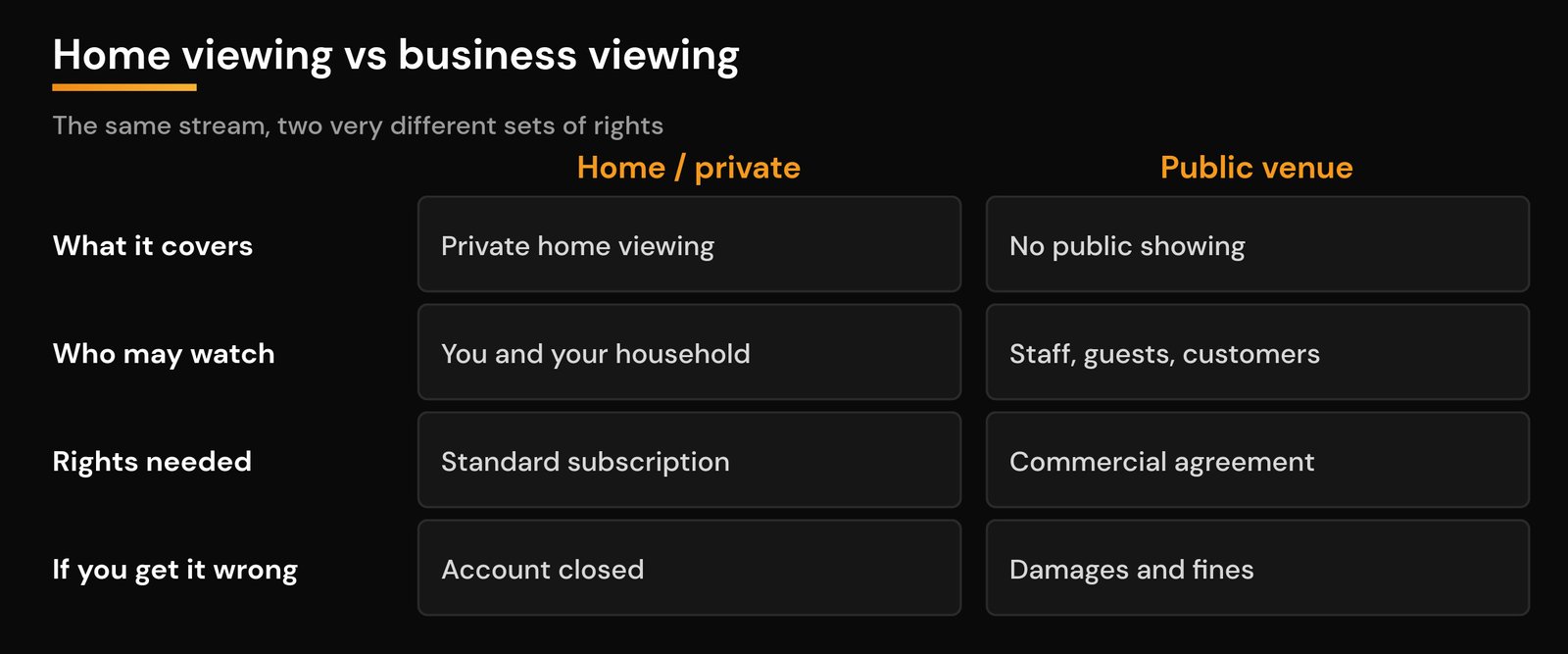
| Question | Home / private | Business / public venue |
|---|---|---|
| What the plan covers | Private viewing inside one household | Nothing — public showing is expressly excluded |
| Who may watch | You, family, ordinary social guests | Staff, customers, hotel guests, members |
| Rights needed | The standard subscription | A commercial agreement, priced by venue size or occupancy |
| Who enforces it | Rarely anyone | Rights-holder agents who visit venues and photograph screens |
| If you get it wrong | Account suspended at worst | Damages, legal costs, licence-review risk |
Notice the last row. Consumer risk and commercial risk are not the same order of magnitude. At home, the worst realistic outcome is a closed account or a letter from your ISP — the sort of thing we walk through in our guide to handling an IPTV copyright notice. For a licensed premises, an unlicensed screening can turn into a civil claim and, in some countries, a mark against the premises licence itself.
The exemption trap: why streaming is treated differently from an aerial
This is the part almost every venue owner gets wrong, and it is the most useful thing in this guide.
Several countries carve out a narrow exemption for small businesses that simply switch on an ordinary domestic TV or radio set. In the US this is the “homestyle exemption” in section 110(5) of the copyright statute, and it is genuinely useful: below defined size thresholds — commonly cited as 3,750 gross square feet for food and drink establishments and 2,000 for other retail, with limits on the number of speakers and screens — a venue receiving a normal broadcast on ordinary equipment does not need a separate performance licence. You can read the statutory language on the US Copyright Office site.
Here is the trap: that exemption is written around the reception of a transmission on a receiving apparatus of a kind commonly used in private homes. It was drafted with an aerial and a TV set in mind. Content delivered by a streaming app, an internet-based service, or an IPTV playlist is generally treated as a fresh transmission by you to your audience — not passive reception of someone else’s broadcast — so it falls outside the exemption entirely. The same reasoning is routinely applied to music streamed from a subscription app in a shop.
The practical consequence is uncomfortable but simple: a small cafe that would be perfectly legal showing a broadcast channel through an aerial can be infringing the moment it shows the same content through a streaming box. Size thresholds will not save an IPTV setup. If you were relying on “we’re under the square-footage limit”, that reliance does not transfer.
Outside the US: same principle, different paperwork
The public-performance principle is close to universal, but the machinery differs:
- UK and Ireland. Non-domestic premises generally need a business-grade TV agreement rather than a consumer one, plus a separate television licence where live broadcast content is shown. Music played in the venue is licensed separately again.
- EU. National law implements the same “communication to the public” right, and case law has repeatedly confirmed that showing broadcast content to customers in a bar or to guests in hotel rooms counts.
- Canada, Australia, New Zealand. Broadly similar: commercial premises need commercial agreements, and collecting societies handle the music side.
- Elsewhere. Enforcement intensity varies enormously, but the underlying obligation usually does not.
One rule travels everywhere: hotel guest rooms are usually treated as public, not private, because the hotel is the one making the transmission available. Putting a consumer streaming stick in every room is one of the most common and most expensive mistakes in hospitality.
What a legitimate commercial setup looks like
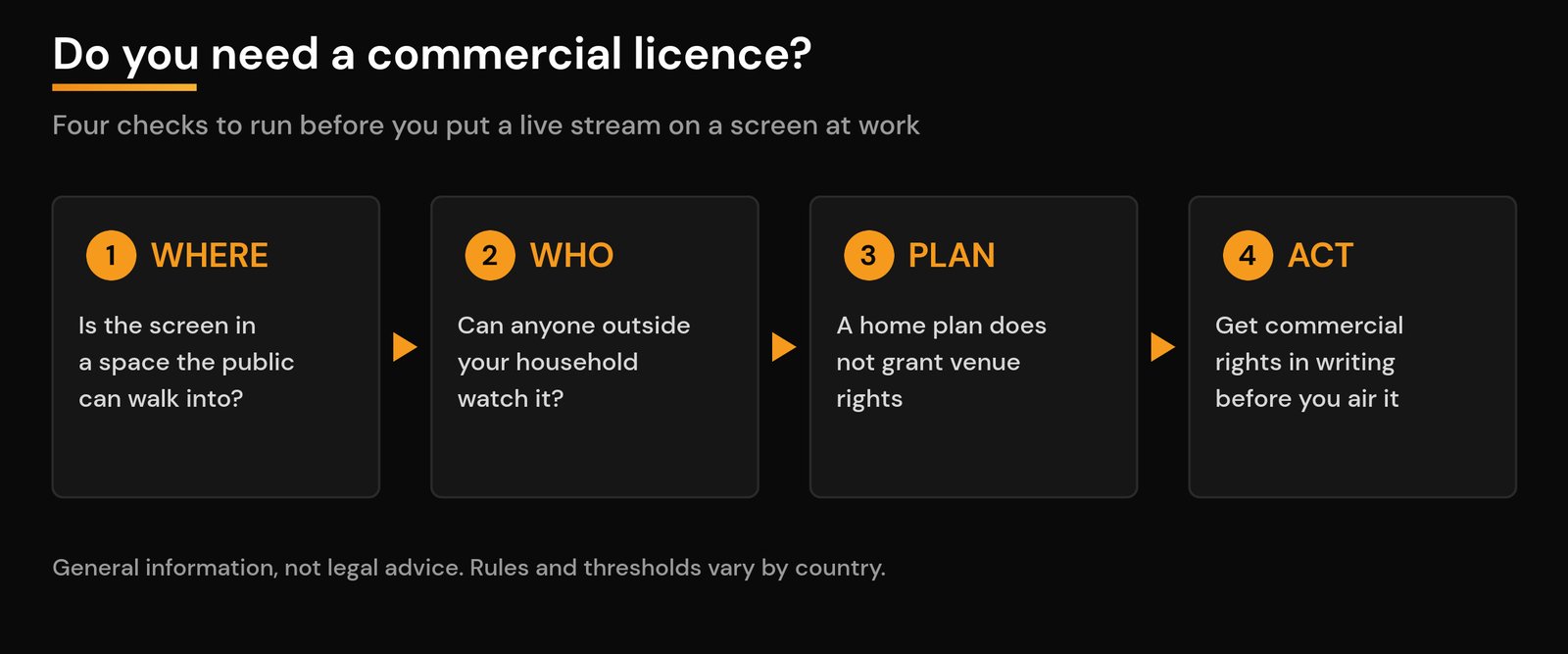
If you want screens on in a commercial space and you want to sleep at night, this is the shape of it:
- Buy a commercial product, not a consumer one. Business packages exist precisely because the rights are different. They cost more because the licence is broader, and pricing is normally banded by rateable value, floor area, or occupancy.
- Get the commercial permission in writing. A contract or licence certificate naming your premises is the thing that protects you. A verbal assurance from a seller is worth nothing in a claim.
- Check who you are actually buying from. Many sellers are intermediaries reselling someone else’s platform and cannot grant venue rights at all — the distinction we unpack in reseller versus provider.
- Licence music separately. Background music, music in ads, and music inside programming are usually handled by different bodies than the video rights. Two licences, two invoices.
- Keep the paperwork visible. Certificates behind the bar, contracts in a folder, renewal dates in a calendar. Enforcement visits are unannounced and the person asking wants documents, not explanations.
- Watch premium one-off events especially closely. Big live events are where enforcement concentrates, and they are frequently sold as separate commercial packages even to venues that already hold a general agreement.
A final sanity check on the seller side: if a service is offering “commercial” access to everything for a price that looks like a consumer plan, that is not a commercial licence, it is a red flag. Our checklist on spotting a fake IPTV service applies with even more force when the buyer is a business.
What actually happens when a venue gets it wrong
Enforcement against businesses is nothing like enforcement against households. Rights holders and their agents run organised programmes: people visit venues, photograph the screen, note the date and time, and keep the evidence. Social media is scraped too — a venue advertising that it will be showing a big event is publishing evidence against itself.
What follows is usually a demand letter with a settlement figure attached, calculated to be cheaper than defending a claim but far more than the commercial licence would have cost. Where cases proceed, damages for wilful copyright infringement can be substantial, and the venue typically pays the other side’s costs as well. In some jurisdictions there is a licensing-authority angle too, where repeat issues become a problem for the premises licence rather than just the bank balance.
There is also a quieter operational risk: a consumer account used commercially tends to hit device and stream limits at exactly the wrong moment, because household plans are provisioned for a household — the ceiling behaviour we describe in our guide to IPTV connection limits. A packed room and a “maximum connections reached” message is a bad evening regardless of the legal position.
Frequently asked questions
Can I use my home IPTV subscription in my shop if nobody is really watching?
No. Liability attaches to making the content available in a public space, not to headcount or attentiveness. A screen visible to customers in a shop is a public showing even if everyone is looking at their phones.
Does muting the audio or showing it without sound make it legal?
No. The video itself is the licensed work. Muting removes one issue — the separate music licence question — but leaves the main problem untouched.
My venue is small. Doesn’t the small-business exemption cover me?
Only for ordinary broadcast reception on domestic equipment, and only in countries that have such an exemption. Streaming and IPTV sources are generally treated as outside it regardless of your floor area, so size thresholds are not a safe harbour for an IPTV setup.
What about the TV in my staff-only break room?
It depends on scale and jurisdiction. A handful of employees in a genuinely private back room is a weaker target than a customer-facing screen, but a large canteen serving many staff has been treated as public in several countries. If in doubt, licence it.
Do hotel guest rooms count as private viewing?
Usually not. Because the hotel is the party making the transmission available to its guests, guest-room viewing is normally treated as communication to the public and needs a commercial hospitality agreement.
How much does a commercial agreement usually cost?
Far more than a consumer plan and far less than a settlement demand. Pricing is typically banded by premises size, occupancy or rateable value, so a small cafe and a large sports bar pay very different amounts. Ask for a written quote naming your address before you commit.
The bottom line
IPTV for business is not a grey area so much as a widely ignored one. The technology changes nothing: if the public can see the screen, you need commercial rights, and a home plan — of any kind, from any provider — does not carry them. The small-business exemptions that rescue an aerial-fed TV set generally do not extend to streaming, so the safest assumption is that your venue needs a proper commercial agreement in writing before anything goes on screen.
Get that one document right and everything else is ordinary business admin. Skip it and you are relying on not being noticed, which is a strategy right up until the moment somebody photographs your screen. If you are still choosing a service, our guide to getting a legal IPTV service is the sensible next stop.
Related guides
- Is IPTV Legal? What the Law Actually Says in 2026
- IPTV Copyright Notice From Your ISP? 7 Smart Steps
- How to Get a Legal IPTV Service the Safe Way
- IPTV Reseller vs Provider: Who You Really Buy From
- Fake IPTV Service? 10 Scam Red Flags to Check
Written by the Nviewx team, who run a premium IPTV service and set up and troubleshoot streaming across Firestick, Android TV, Apple TV, smart TVs and mobile every day. This article is general information about how public-performance rules work and is not legal advice for your specific premises.