Skip to content


Monthly vs Yearly IPTV: Which Subscription Actually Saves You More? (2026)
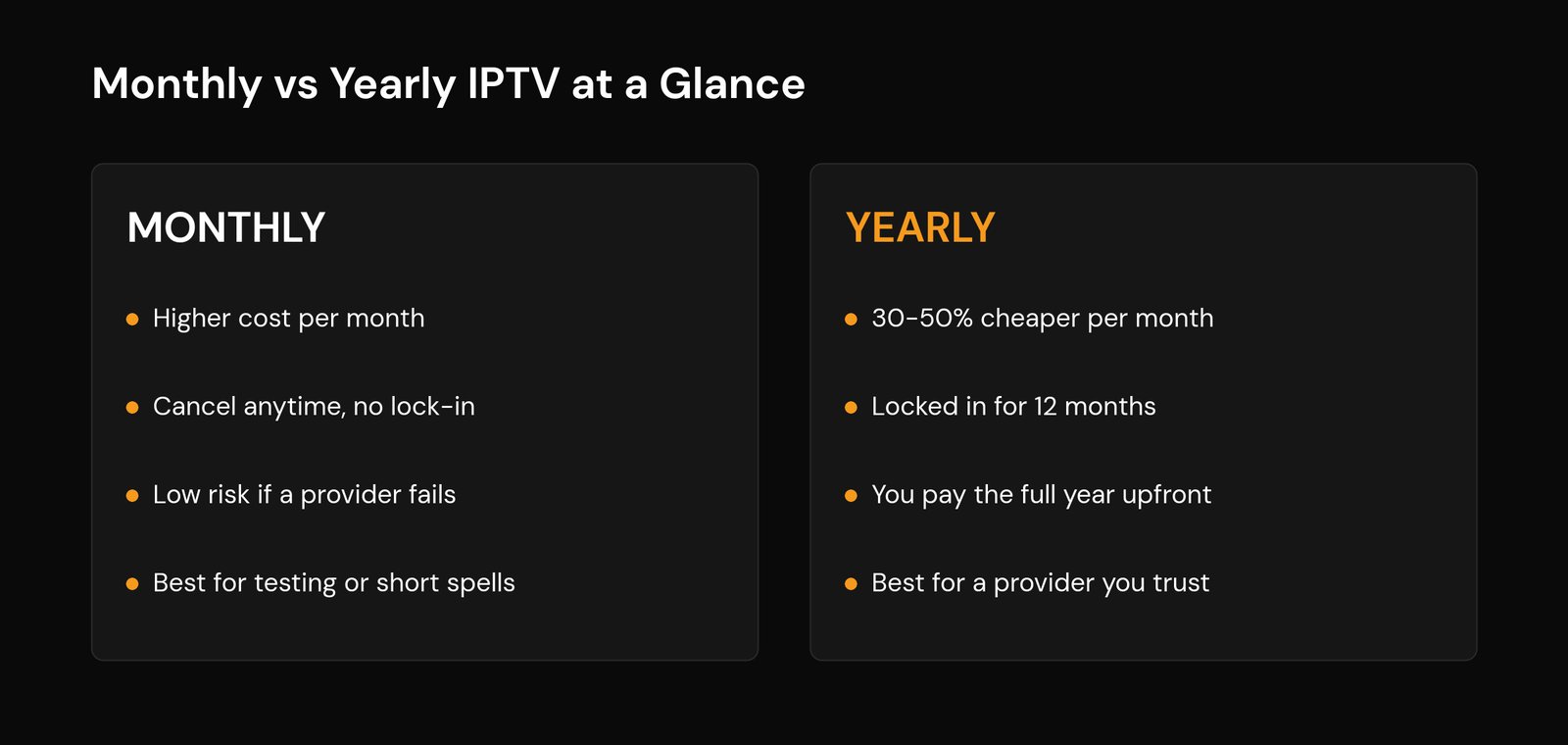
The monthly vs yearly IPTV decision really comes down to two things pulling in opposite directions: savings and risk. A yearly subscription to an IPTV service almost always costs 30-50% less per month than paying month to month, so on price alone the annual plan wins. The catch is that you hand over a full year of money upfront to a service you may have used for only a few days, and if that provider disappears, you lose the lot.
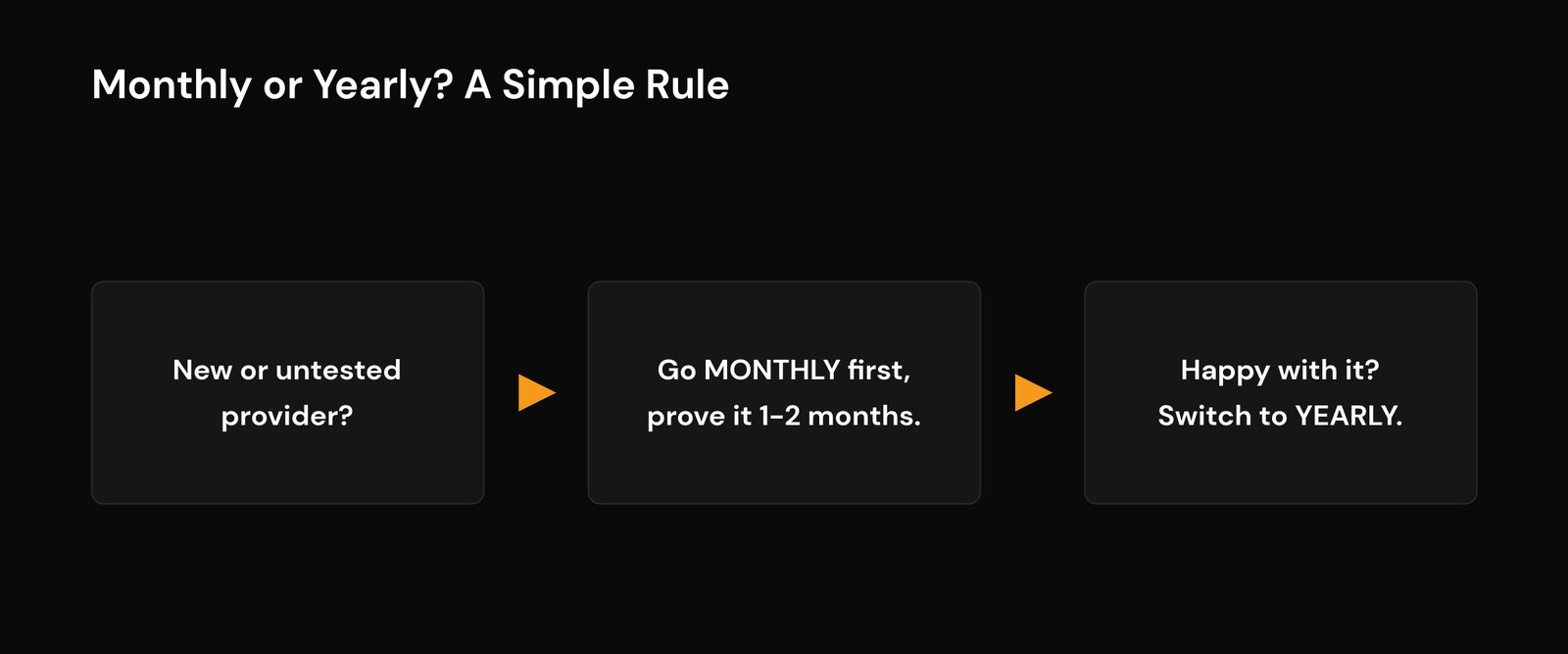
So the honest answer is not “yearly is cheaper, buy yearly.” It is a sequence: start monthly, prove the service is stable and honest, then move to yearly once it has earned it. This guide breaks down the real price difference, the trade-off nobody selling you a plan wants to mention, and a simple rule for choosing without getting burned.
| Factor | Monthly plan | Yearly plan |
|---|---|---|
| Upfront cost | Low (one month) | High (full year) |
| Effective monthly price | Highest | 30-50% lower |
| Commitment | None, cancel anytime | Locked in 12 months |
| Risk if provider disappears | One month lost | Whole year at risk |
| Best for | Testing, seasonal viewing | A provider you already trust |
The quick answer: which one should you pick?
If you are new to a provider, or to IPTV in general, pick monthly. It caps your downside at one month of money while you find out whether the streams hold up during peak hours, whether the channel list matches what was advertised, and whether support actually replies. If you have already run a provider for a couple of months and it has been reliable, switch to yearly and pocket the discount. That is the whole strategy in two sentences.
The mistake people make is jumping straight to a yearly (or worse, “lifetime”) plan to grab the biggest discount on day one, before they know anything about the service. That is also exactly what a scam provider is counting on. Before committing to anything, it helps to understand who you are actually buying from and to take advantage of a short free trial first.
What you actually pay each way
Prices vary, but the shape is consistent across the market. Monthly plans sit around $10-15. Yearly plans work out to roughly $5-7.50 per month once you divide the annual price across twelve months, because the provider is happy to discount heavily in exchange for a year of revenue locked in on day one. For the full ranges, see our guide to what IPTV actually costs.
| Billing | Typical price | Effective per month | Best for |
|---|---|---|---|
| Monthly | $10-15 / month | $10-15 | Testing, short-term use |
| Quarterly | $25-35 / quarter | ~$9-12 | A small saving, short commitment |
| Yearly | $60-90 / year | $5-7.50 | Daily use, a proven provider |
Put simply, a year paid monthly at $12 costs about $144; the same service on an annual plan might be $80-90. That gap, the equivalent of three or four free months, is real money, and it is why the yearly plan is tempting. The question is never whether the discount exists. It is whether the provider will still be there in month eight to honour it.
The trade-off nobody mentions: the discount vs the risk
IPTV runs on a subscription business model, and most providers are small, unregulated operations. That matters when you prepay a year. If a provider oversells its servers, gets taken offline, or simply vanishes with the money, a monthly customer loses at most one payment. A yearly customer loses everything they paid, and there is usually no refund process and no regulator to complain to.
This is the part the “save 40%” sales pages skip. The yearly discount is not free money; it is you taking on the provider risk in exchange for a lower price. That can be a smart trade, but only once the provider has shown, over real use, that it is stable. Paying yearly for a service you tried for three days is not saving money, it is gambling it.
When a monthly IPTV subscription is the smarter buy
A monthly IPTV subscription is the right call when:
- You are testing a new provider and have not yet confirmed it is reliable.
- You only watch heavily for part of the year, such as a season or a few winter months, and want to pause the rest of the time.
- You are on a tight budget and prefer small, predictable payments over one large charge.
- You are not yet sure the service is legitimate. If in doubt, keep your exposure to a single month.
Flexibility is the whole point of monthly. You can cancel the moment a service disappoints, and you have lost almost nothing.
When a yearly IPTV subscription is worth it
A yearly IPTV subscription makes sense once the boxes are ticked:
- You have run the provider for at least one to two months with stable streams.
- You watch most days, so the per-month saving genuinely adds up over the year.
- Support has answered you at least once, and the channel list matched what was promised.
- You are paying with a method that gives you some recourse if things go wrong (more on that below).
At that point the annual plan is the better deal: you lock in the lower rate, and you stop thinking about renewals for twelve months.
What about lifetime IPTV plans?
Treat “lifetime” plans with real caution. No small, unregulated streaming operation can credibly promise service for life, and many “lifetime” deals quietly mean the lifetime of the server, not yours. The pattern is common: take a large one-off payment, run for a few months, then shut down and reopen under a new name. If a yearly plan already asks you to trust a provider for twelve months, a lifetime plan asks you to trust it forever, on day one. The math almost never works in your favour.
How to get the yearly discount without the risk
You do not have to choose between saving money and staying safe. Follow this order:
- Trial first. Use a free or 24-48 hour trial to check streams, channels and stability before any real money changes hands.
- Pay monthly for one to two months. Treat it as a paid audition. Watch during peak evening hours, when weak providers fall apart.
- Judge on evidence. Stable during peak times, an honest channel list, and support that replies is a provider worth committing to.
- Then go yearly. Only now do you upgrade to the annual plan and take the discount.
- Pay with protection. Prefer a method with buyer protection, such as a card, which can support a chargeback if the service is never delivered. Avoid irreversible transfers for large yearly payments.
It is also worth confirming whether IPTV is legal where you live and choosing the best IPTV app for your device before you lock in a long plan. Switching apps is easy; switching a provider you have prepaid a year to is not.
Frequently asked questions
Is a yearly IPTV subscription cheaper than monthly?
Yes. A yearly plan typically works out 30-50% cheaper per month than paying month to month, because the provider locks in a year of revenue upfront and passes some of it back as a discount. The saving is real; the risk is that you pay it all in advance.
Should I pay for a year of IPTV upfront?
Only after you have tested the provider for one to two months on a monthly plan and it has stayed stable. Prepaying a year for a service you have barely used means losing everything if it disappears, which is common with small, unregulated providers.
Are lifetime IPTV subscriptions worth it?
Rarely. No unregulated provider can genuinely guarantee service for life, and “lifetime” often means the life of the server, not yours. Many take a large one-off payment and vanish within months. The bigger the upfront commitment, the bigger the risk.
Can I switch from monthly to yearly later?
Almost always. Most providers are happy to move you onto an annual plan whenever you want, since it locks in your business. Starting monthly costs you nothing in flexibility; you simply upgrade once you trust the service.
What is the safest way to pay for a yearly plan?
Use a payment method with some buyer protection, such as a credit or debit card that allows a chargeback if the service is never delivered. Avoid irreversible bank transfers or gift-card style payments for a large annual charge.